The Invention of the Zipper
The zipper took more than forty years and three inventors to get right, which is remarkable given how simple the finished product looks. Its history is mostly a story of people solving a problem nobody was sure they had.
Elias Howe, who had patented his sewing machine five years earlier, patented an "Automatic, Continuous Clothing Closure" in 1851. It used a series of clasps joined by a single cord running along the seam. Howe never marketed it. He was making enough money from sewing machine royalties that the closure device sat in the patent office gathering dust, which turned out to be a recurring theme in zipper history.
Forty-two years later, Whitcomb Judson, a Chicago engineer, independently invented a similar device he called the "Clasp Locker." He debuted it at the 1893 World's Columbian Exposition in Chicago, the same fair that introduced the Ferris wheel. The Clasp Locker was meant for boots—the idea being that people were tired of fumbling with dozens of tiny buttons and hooks every time they put on shoes. It worked, technically, but had a tendency to pop open at inconvenient moments. Judson founded the Universal Fastener Company to sell it. Sales were dismal.
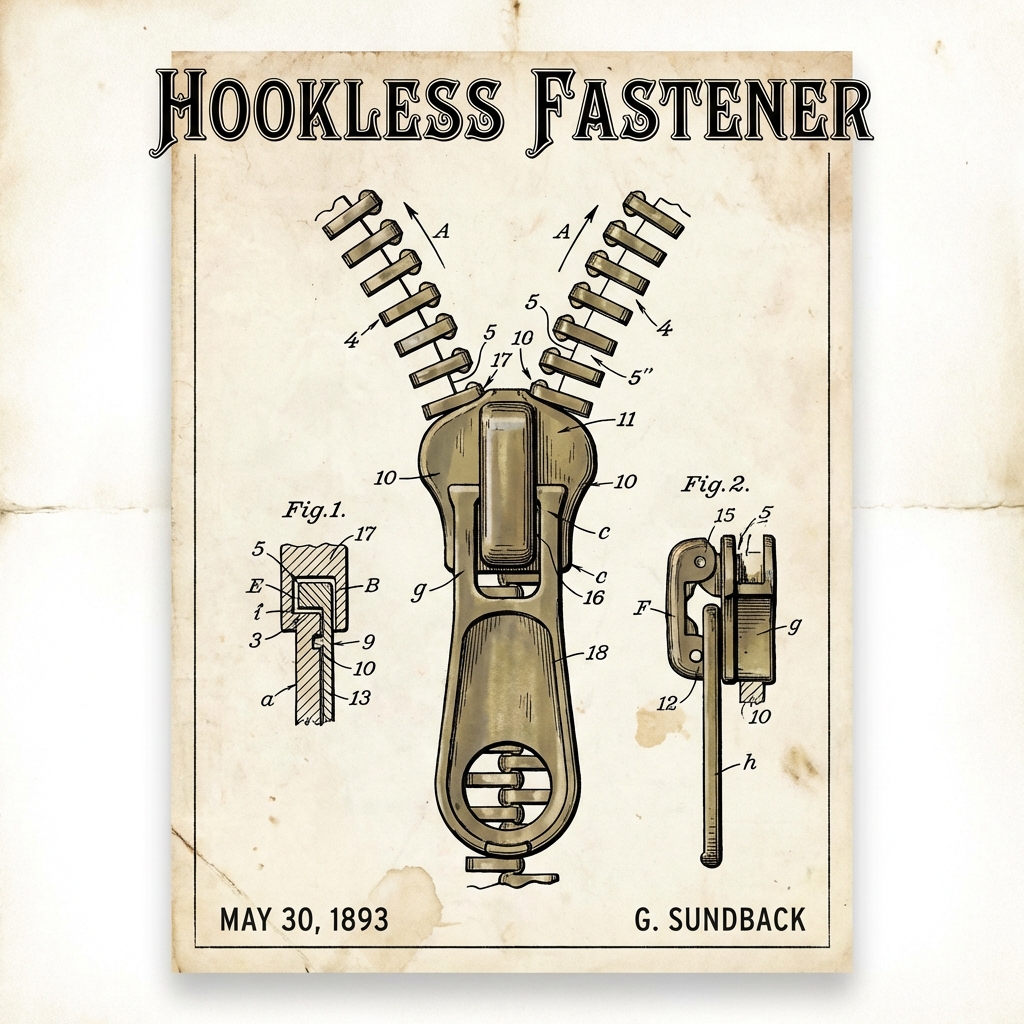
The person who actually made the zipper work was Gideon Sundback, a Swedish-born electrical engineer who joined Judson's company in 1906. By 1913, Sundback had redesigned the device entirely. He increased the number of interlocking teeth from four per inch to ten or eleven, created two facing rows of teeth that meshed together with a single slider, and devised a manufacturing machine that could stamp them out reliably. He called it the "Hookless Fastener." It was, for all practical purposes, the modern zipper.
The name "zipper" didn't arrive until 1923, when the B.F. Goodrich Company used Sundback's fasteners on their rubber galoshes and trademarked the word for the sound the device made. The name was meant to describe the boots, not the fastener, but it migrated anyway. The fashion industry resisted zippers for years—buttons and hooks were considered more dignified—until the 1930s, when designers finally began sewing them into trousers and dresses. Children's clothing adopted them first, marketed to parents as something kids could operate on their own.
By then, Howe had been dead for over sixty years, Judson for over two decades, and Sundback was in his fifties, watching an idea he'd perfected finally become ordinary.
Filed under The 1800s, Inventions, AmericaFurther reading: Wikipedia
Print it for the office looPick your next sheet
Judge a story by its emoji. No peeking at titles.