Kiruna — The Town That Moved
Kiruna, Sweden's northernmost city, sits 145 kilometers above the Arctic Circle on top of one of the largest and purest iron ore deposits on Earth. The ore is the reason the town exists. It is also the reason the town has to move.
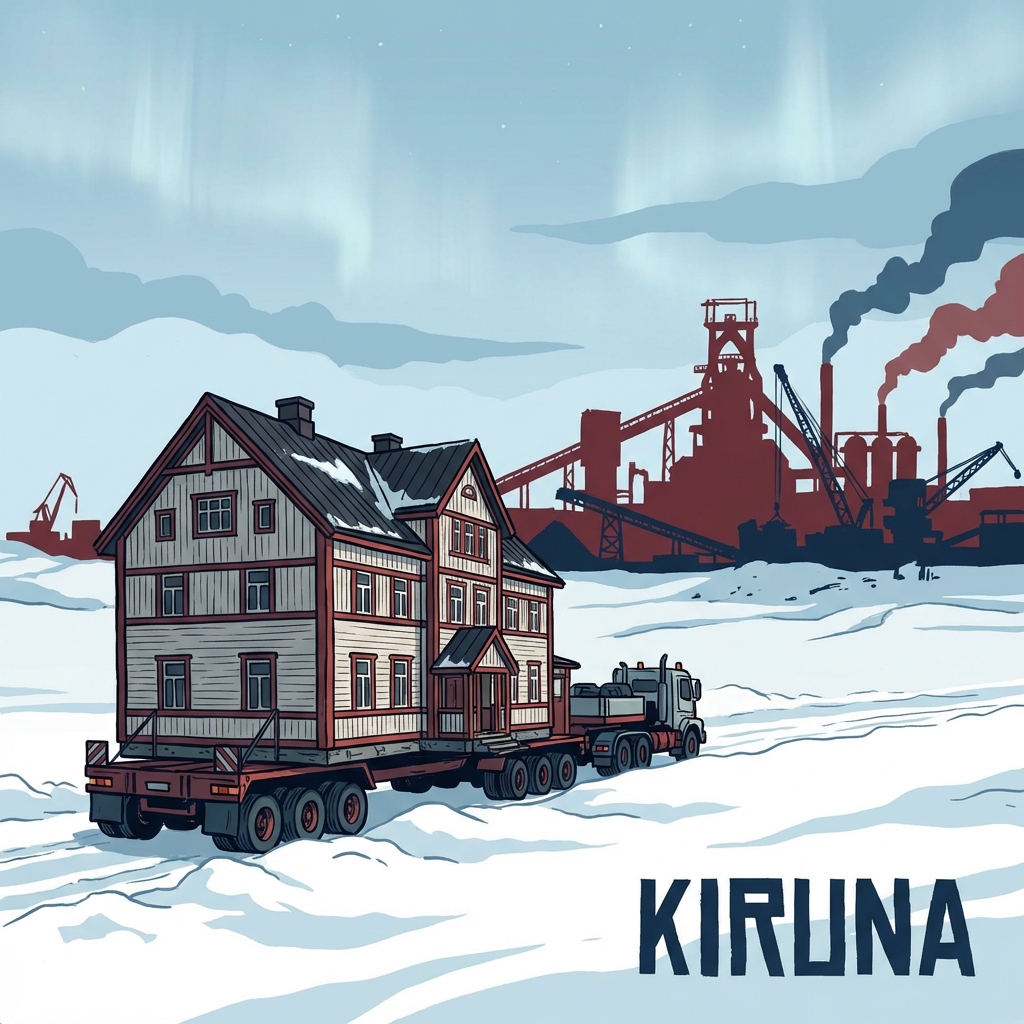
For over a century, the state-owned mining company LKAB has been extracting iron from beneath Kiruna. The underground mine now extends more than a kilometer deep, and the excavation has created voids that are causing the ground above to sink. Cracks have appeared in buildings. Streets have shifted. In 2004, officials determined that continuing to mine the 1.8 billion tonnes of remaining ore would require relocating the entire town center three kilometers to the east.
The relocation is not a demolition-and-rebuild project. Kiruna is physically moving its buildings. Twenty-one of the most historically significant structures are being transported intact to new foundations. In August 2025, the 113-year-old Kiruna Church, a timber building weighing 672 tons, was loaded onto specialized trailers and driven to its new location over two days. The town hall, a 1960s modernist landmark, was similarly relocated.
For residents, LKAB offers the market value of their property plus 25 percent, or a newly constructed home at the new site. About 90 percent have chosen new construction. By 2035, when the new city center is expected to be fully operational, approximately 6,000 people and 2,700 homes will have been relocated. The total cost is estimated at 22.5 billion Swedish kronor—roughly 2.4 billion US dollars.
The new town center already includes a city hall called Kristallen (the Crystal) and a relocated county art museum. Roads, schools, and commercial buildings are under construction. What was once the center of Kiruna is gradually being demolished as residents leave, the ground reclaimed by the expanding mine.
LKAB produces 80 percent of all iron ore mined in the European Union. The ore beneath Kiruna is too valuable to leave in the ground, so the town above it keeps moving east.
Filed under Modern Times, Disasters & Drama, InventionsFurther reading: BBC
Print it for the office looPick your next sheet
Judge a story by its emoji. No peeking at titles.