How Velcro Was Inspired by Burrs
In 1941, Swiss engineer George de Mestral took his Irish pointer for a walk through the woods near the Alps. When they returned home, both man and dog were covered in burrs from burdock plants.
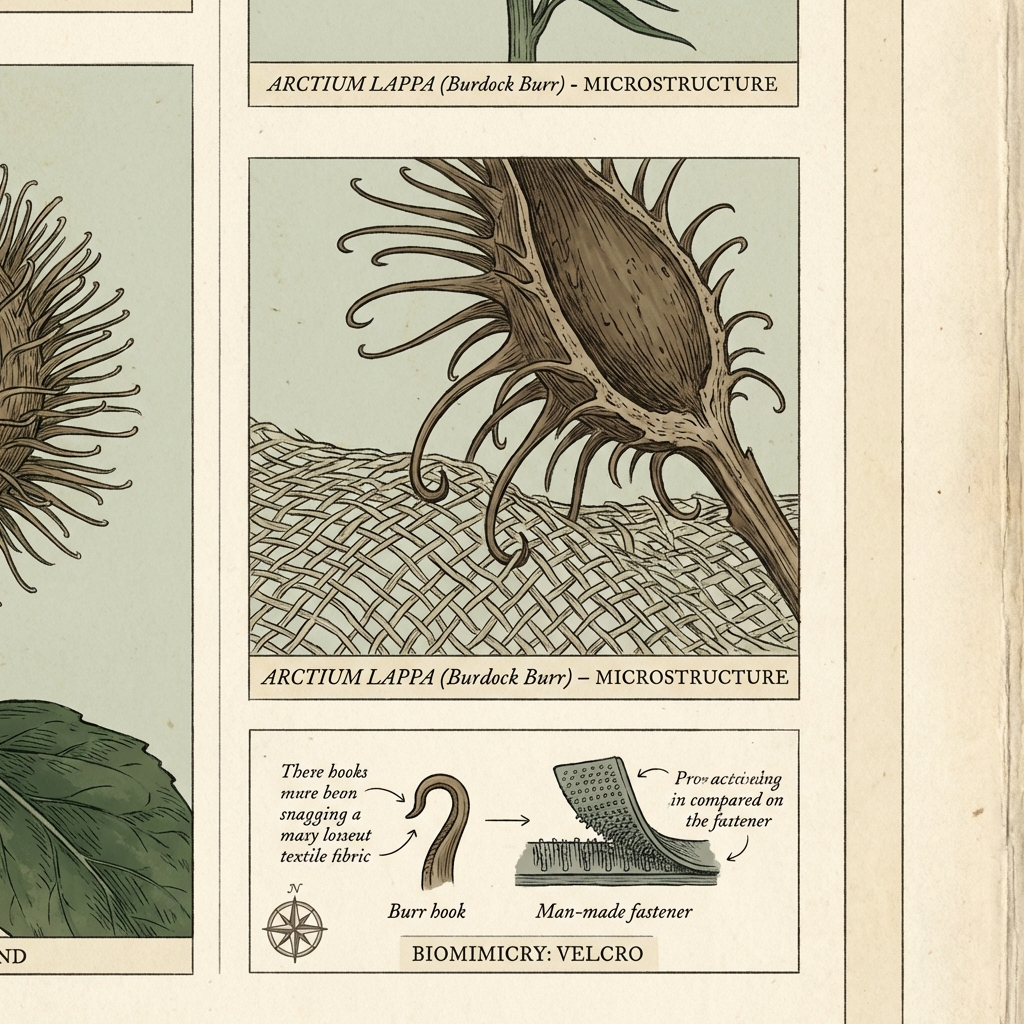
De Mestral had removed these stubborn seeds from his clothing countless times before, but on this occasion he decided to examine one under a microscope.
What he found was a surface covered in thousands of tiny hooks. Each hook was stiff and curved, shaped perfectly to snag the looped threads of fabric or strands of fur. The burr's design was remarkably simple and remarkably effective—a fastening system that nature had perfected over millions of years of evolution.
De Mestral spent the next decade trying to manufacture the concept. His early attempts used cotton, which wore out quickly. Most people refused to take him seriously; the idea of a hook-and-loop fastener sounded like a novelty with no practical use. He eventually turned to nylon, a synthetic fiber that had only recently been invented. Through trial and error, he discovered that sewing nylon under hot infrared light caused it to form small hooks.
He submitted his patent application in Switzerland in 1951 and received approval in 1955. He named his invention Velcro, a combination of the French words velours (velvet) and crochet (hook). Within a few years, he had opened manufacturing facilities across Europe and expanded to the United States, setting up shop in the textile hub of Manchester, New Hampshire.
The product remained something of an oddity until NASA discovered it. The space agency needed a way to secure objects in zero gravity, and hook-and-loop fasteners were perfect for the job. Suddenly, Velcro wasn't a gimmick—it was space-age technology. Astronauts used it to fasten food pouches, secure equipment, and even attach themselves to walls.
De Mestral's walk in the woods became one of the most famous examples of biomimicry in engineering history. He died in 1990, having watched his invention become ubiquitous.
Filed under Inventions, Animals & Nature, EuropeFurther reading: Smithsonian Magazine
Print it for the office looPick your next sheet
Judge a story by its emoji. No peeking at titles.