Why Golf Balls Have Dimples
A smooth golf ball hit by a professional golfer would travel only about half as far as one with dimples. The textured surface seems counterintuitive—generally, smooth objects are more aerodynamic than rough ones—but golf balls operate under conditions where the opposite turns out to be true.
Early golf balls were smooth. The first were leather spheres stuffed with feathers, followed in the mid-1800s by balls made from gutta-percha, a rubber-like substance. Golfers began noticing that older, scuffed balls flew farther and straighter than new ones. By the late 19th century, players were deliberately nicking their new balls to improve performance. Manufacturers took the hint, and by 1905, golf balls were being produced with dimples.
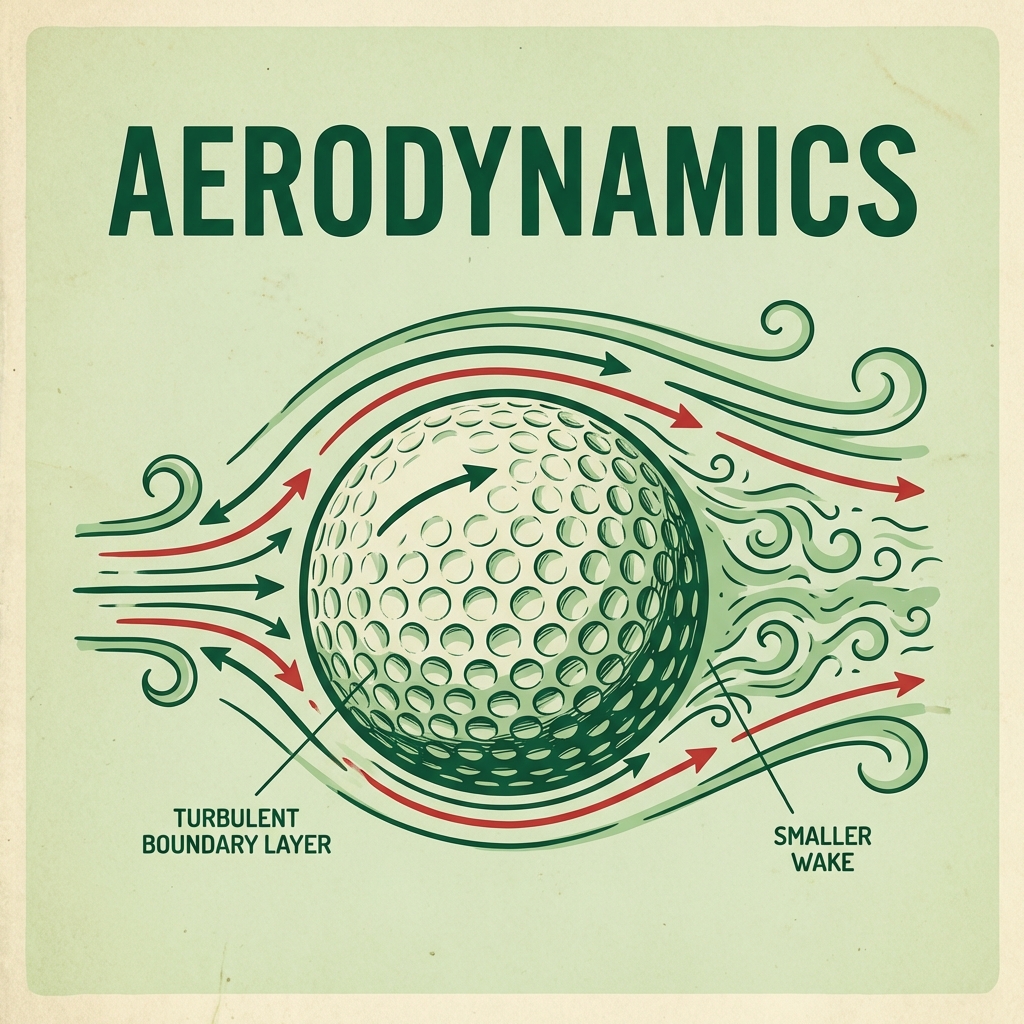
The physics involves something called the boundary layer, the thin cushion of air immediately surrounding the ball as it flies. On a smooth ball, this layer remains laminar—orderly and smooth—until it separates from the surface relatively early, creating a large turbulent wake behind the ball. That wake acts like a parachute, pulling the ball backward and slowing it down.
Dimples force the boundary layer to become turbulent earlier, but this turbulence actually helps the air cling to the ball's surface longer before separating. The result is a much smaller wake and significantly less drag. The trade-off involves slightly more friction against the ball's skin, but the reduction in pressure drag more than compensates. At typical golf ball speeds around 70 miles per hour, dimples can reduce drag by nearly 50 percent.
Modern golf balls have between 300 and 500 dimples, each about 0.010 inches deep. That depth is calibrated precisely: a change of just 0.001 inches can dramatically alter the ball's trajectory and distance. Manufacturers spend considerable resources testing dimple patterns, shapes, and distributions.
The golfers who first noticed that beat-up balls outperformed pristine ones had no idea why. They just knew their shots went farther when the surface was rough.
Filed under Culture & Words, The 1800s, ScienceFurther reading: Scientific American
Print it for the office looPick your next sheet
Judge a story by its emoji. No peeking at titles.