How the Microwave Oven Was Accidentally Invented
In 1945, a self-taught engineer named Percy Spencer was walking through a radar testing room at Raytheon when he noticed the chocolate bar in his pocket had melted. He was standing near a magnetron, the vacuum tube that powers radar systems, and he realized the microwaves it emitted had heated his candy.
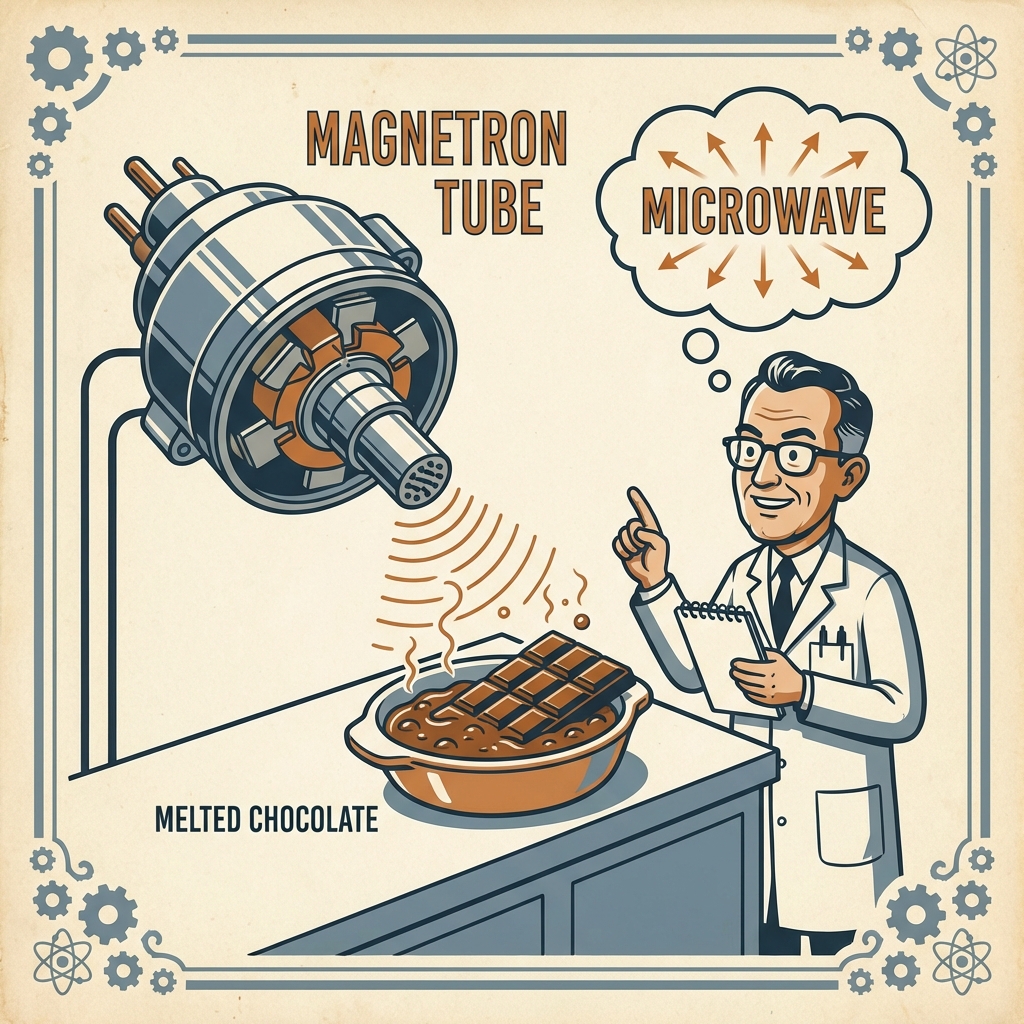
Spencer was not the first person to notice this phenomenon. Radar operators had long observed that working near magnetrons produced a warming sensation. But Spencer was the first to investigate it. He aimed the magnetron at a bag of popcorn kernels and watched them pop. He pointed it at an egg, which cooked so quickly it exploded.
Spencer's path to this discovery was unlikely. Orphaned twice as a child in Maine, he never finished grammar school. He went to work in factories at twelve and taught himself calculus, physics, and chemistry during night shifts. By the time he joined Raytheon, he had become one of the company's most valued engineers, known for solving problems that stumped formally trained colleagues. He eventually held around 300 patents.
Raytheon filed for a patent on October 8, 1945, and the company released the first commercial microwave oven, the RadaRange, in 1947. It stood nearly six feet tall, weighed over 750 pounds, consumed 3,000 watts of power, and cost roughly $5,000. The market was limited to restaurants, ships' galleys, and industrial cafeterias.
Smaller, cheaper models for home use followed in the 1960s, and by the 1970s, microwave ovens had become common kitchen appliances. Today, over 90 percent of American households own one.
For his invention, Percy Spencer received no royalties. Raytheon paid him a one-time gratuity of two dollars—the same token payment the company gave to all employees for patents filed on its behalf.
Filed under Inventions, America, The 1900sFurther reading: Smithsonian Magazine
Print it for the office looPick your next sheet
Judge a story by its emoji. No peeking at titles.