The Immortal Jellyfish
A jellyfish smaller than a pinky fingernail has figured out how to cheat death. Turritopsis dohrnii, found in temperate and tropical oceans worldwide, is the only known animal that can reverse its life cycle and become young again.
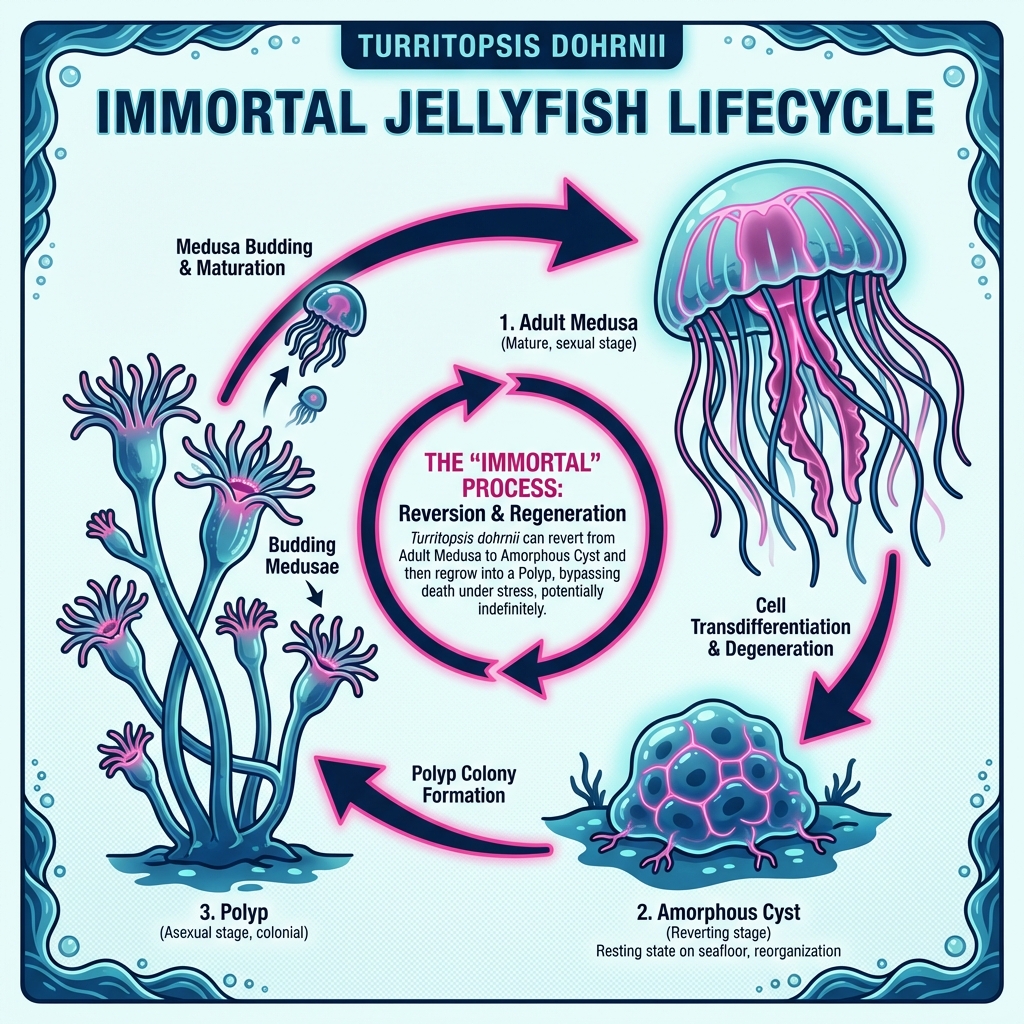
Most jellyfish follow a predictable path: they begin as larvae, settle on the ocean floor as polyps, and eventually bud off as free-swimming medusae—the bell-shaped adults we recognize as jellyfish. When medusae age or get injured, they die. But Turritopsis dohrnii has developed an alternative.
When stressed by physical damage, starvation, or disease, the adult jellyfish doesn't die. Instead, it shrinks in on itself, reabsorbs its tentacles, and sinks to the seafloor as a blob-like cyst. Over the next 24 to 36 hours, this cyst transforms back into a polyp—the creature's juvenile stage. The polyp then matures normally, budding off new medusae that are genetically identical to the original. The process is something like a butterfly transforming back into a caterpillar, then metamorphosing into a butterfly again.
The mechanism behind this is called transdifferentiation. Specialized adult cells reprogram themselves to become entirely different cell types, allowing the jellyfish to rebuild its body in a completely different form. Genetic studies have found that during this reversal, the jellyfish activates genes related to telomere maintenance—the cellular structures that typically shorten with age—and DNA repair, essentially resetting the biological clock at the cellular level.
In theory, the cycle can repeat indefinitely. In practice, individual jellyfish still die; most are eaten by predators or killed by disease before they can trigger the reversal. But the capability exists.
Scientists studying Turritopsis dohrnii are interested in whether the same cellular mechanisms could someday be applied to human medicine—using transdifferentiation to replace damaged tissue or reverse age-related degeneration. The research is still early. But a 4.5-millimeter jellyfish has demonstrated that aging, at least in one species, is not necessarily a one-way process.
Filed under Animals & Nature, ScienceFurther reading: Wikipedia
Print it for the office looPick your next sheet
Judge a story by its emoji. No peeking at titles.