Why Manhole Covers Are Round
For decades, one question haunted job interviews at Microsoft, Google, and countless other tech companies: why are manhole covers round?
The question was meant to test problem-solving under pressure, to see if candidates could reason through an unfamiliar problem. But there's an actual answer, and it has nothing to do with lateral thinking exercises.
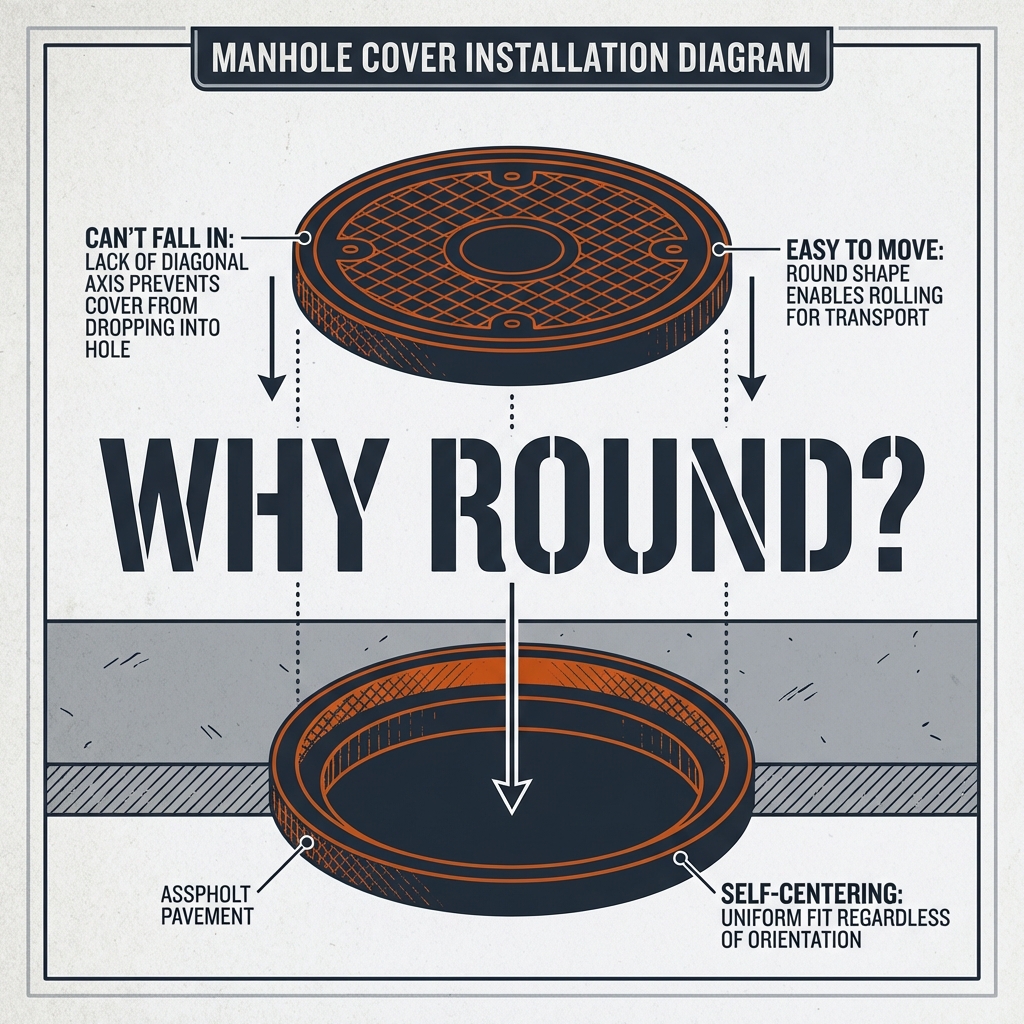
A round cover cannot fall through its own hole. This is geometry, not philosophy. A circle has a constant width in every direction—its diameter is the same whether you measure it horizontally, vertically, or at any angle. A square cover, by contrast, could slip through diagonally, since the diagonal of a square is about 1.4 times longer than its sides. Tip a square cover the right way and it drops straight down the shaft. A round cover, no matter how you orient it, simply won't fit through the opening it's meant to seal.
The engineering goes deeper than just not killing maintenance workers. Underground, the cylindrical shape resists the compression of the surrounding earth more effectively than corners would. Above ground, when trucks roll over the cover, the circular rim distributes weight evenly around its entire circumference. No weak points, no stress concentrations.
There are practical benefits too. A round cover can be rolled along the street rather than carried, which matters when you're dealing with something that weighs between 90 and 150 pounds. It can be set back in place from any angle—no lining up corners, no flipping it around to find the right orientation. In France, many covers lock with a quarter turn, requiring a special tool to open, which keeps unauthorized people out of the sewers.
The math also favors circles. A round cover uses less material than a square cover of equivalent span, since you're not filling in corners that add weight without adding coverage. Foundries can machine round castings more easily on a lathe.
There is, for what it's worth, one other shape that shares the circle's constant-width property: the Reuleaux triangle, a curved triangle that looks like a guitar pick. It would work just as well for preventing falls. But it doesn't roll, so the circle won.
Filed under Inventions, QuirkyFurther reading: Scientific American
Print it for the office looPick your next sheet
Judge a story by its emoji. No peeking at titles.