Ball Lightning
In 1638, a "great ball of fire" reportedly came through the window of a church in Devon, England, injuring about sixty people.
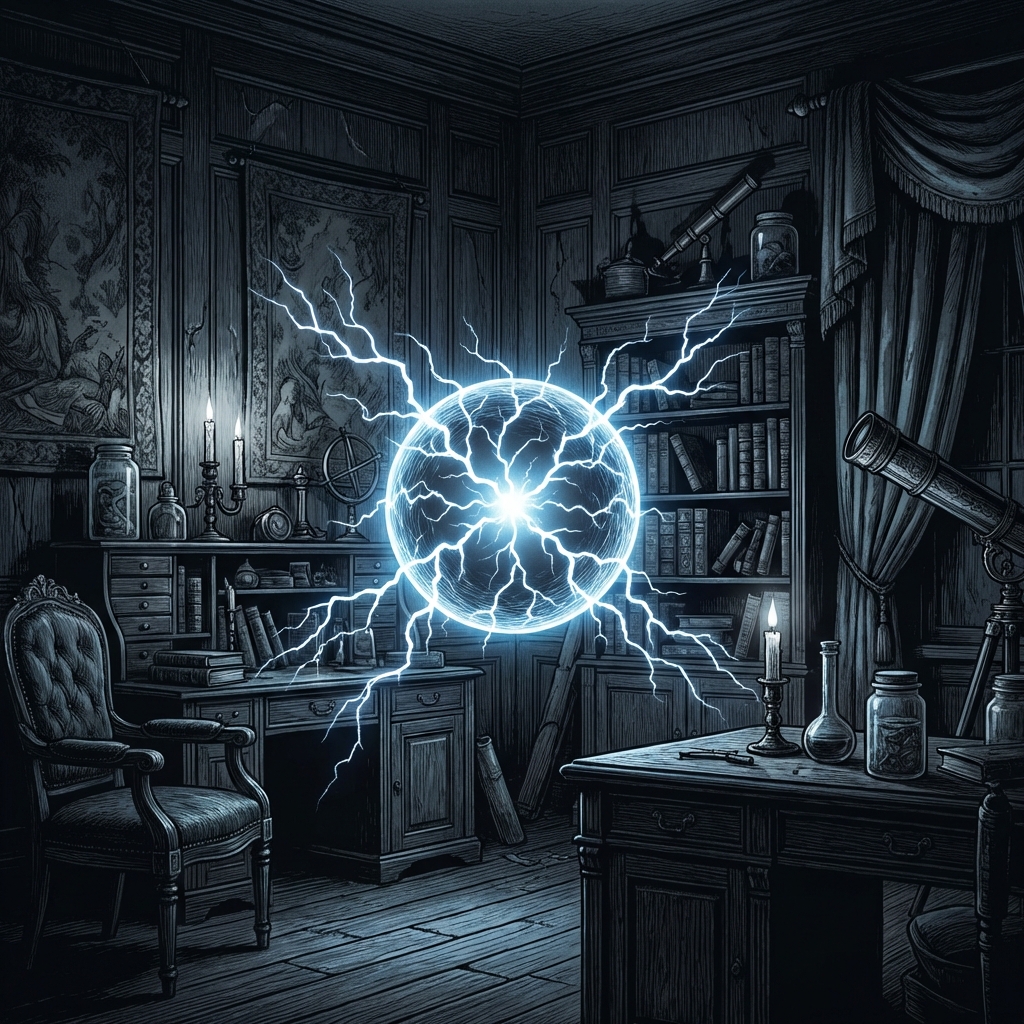
In 1753, the Russian scientist Georg Richmann was killed in his Saint Petersburg laboratory when a glowing blue-white sphere struck his head during a lightning experiment. World War II pilots reported small luminous balls following their aircraft, moving in ways that defied explanation—they called them foo fighters. Nearly five thousand witness reports exist in the scientific literature, collected over centuries. And yet ball lightning remains one of the least understood phenomena in atmospheric science.
The descriptions are consistent enough to be unsettling. A glowing sphere, anywhere from the size of a pea to a meter across, appears during or just after a thunderstorm. It can be blue, orange, yellow, or white. It floats, sometimes drifting against the wind, sometimes passing through solid walls. It hisses. It smells acrid. It lasts anywhere from a few seconds to a minute—far longer than any electrical discharge should—and then it vanishes, sometimes with an explosion.
The problem is that almost nobody has ever captured it on film, let alone measured it with instruments. In 2012, researchers at Northwest Normal University in Lanzhou, China, accidentally recorded what appears to be ball lightning while studying an ordinary thunderstorm. Their spectrometers detected silicon, iron, and calcium in the glowing orb—elements present in the local soil—which supported one theory: that lightning striking the ground might vaporize silica, and that the recombining silicon could glow as it floats and oxidizes. But that's one recording, of one event, and it doesn't explain how the phenomenon sustains itself.
Other theories propose plasma trapped by microwaves, or ionized air vortices, or even hallucinations induced by the magnetic fields of storms. The consensus is that there is no consensus. "There are literally dozens of ball lightning theories," one researcher noted, "because it's an unconstrained situation."
Something is happening out there—too many credible witnesses have seen it—but science hasn't caught up yet. Ball lightning remains, for now, a thing people see that refuses to be explained.
Filed under Mysteries, Animals & Nature, ScienceFurther reading: Wikipedia
Print it for the office looPick your next sheet
Judge a story by its emoji. No peeking at titles.