The Origin of OK
On March 23, 1839, the Boston Morning Post published two letters that would become the most recognized word on Earth.
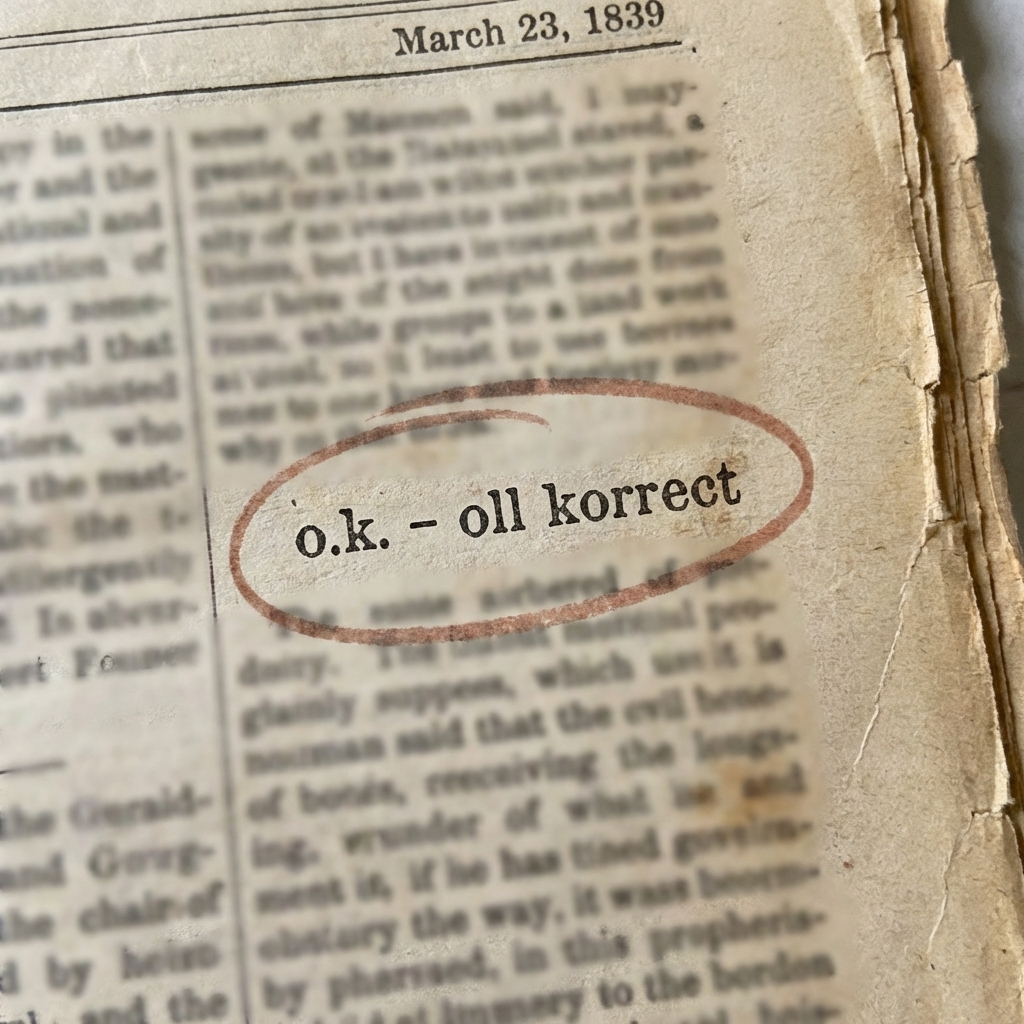
The newspaper's editor, Charles Gordon Greene, wrote "o.k." as a joking abbreviation for "oll korrect," a deliberate misspelling of "all correct." It was meant as a throwaway quip mocking a rival paper.
The joke only made sense in context. During the late 1830s, educated young Americans had developed a fad for intentionally misspelling words and then abbreviating them. It was the text-speak of its era. Popular slang included "KY" for "know yuse" (no use), "KG" for "know go" (no go), and "OW" for "oll wright" (all right). Most of these abbreviations vanished within a few years. OK did not.
The expression might have faded like the others had the 1840 presidential election not arrived at exactly the right moment. Martin Van Buren, the Democratic incumbent running for reelection, happened to be from Kinderhook, New York. His supporters formed "O.K. Clubs" and claimed the letters stood for "Old Kinderhook." Van Buren lost the election, but the slogan had pushed OK into national vocabulary.
The true etymology remained murky for over a century. Competing theories claimed OK derived from a Choctaw word, a German expression, a Haitian port, or even the initials of a biscuit company. It wasn't until the 1960s that Allen Walker Read, a Columbia University linguist, traced the term back to that Boston newspaper column. His 1963-1964 research papers were so thorough that most dictionaries now cite his findings without reservation.
OK spread from American English to virtually every language on the planet. It appears in Russian, Japanese, Swahili, and dozens of other languages, usually with the same spelling and approximate pronunciation. Linguists estimate it may be the most widely understood word in human history, all because a newspaper editor in Boston thought intentional misspelling was funny.
Filed under Culture & Words, The 1800s, AmericaFurther reading: Smithsonian Magazine
Print it for the office looPick your next sheet
Judge a story by its emoji. No peeking at titles.