Leap Seconds
The Earth is slowing down. It has been for billions of years.
The gravitational pull between our planet and the moon creates tides, and as those tides drag across the seafloor, friction gradually bleeds away rotational energy. Back in the age of dinosaurs, a day lasted about 23.5 hours. The process continues, imperceptibly, day by day.
This wouldn't matter much if we still told time by the sun. But we don't. In 1967, the international standards body redefined the second based on atomic physics: specifically, the duration of 9,192,631,770 oscillations of a cesium-133 atom. Atomic clocks are extraordinarily precise—they lose about one second every 300 million years—but they don't care what the Earth is doing. As the planet's rotation slows, atomic time and astronomical time gradually drift apart.
To fix this, scientists invented the leap second. Starting in 1972, the Bureau International des Poids et Mesures began occasionally adding a single second to Coordinated Universal Time, keeping atomic clocks roughly synchronized with the actual position of the sun. Twenty-seven leap seconds have been added since then, the most recent on December 31, 2016.
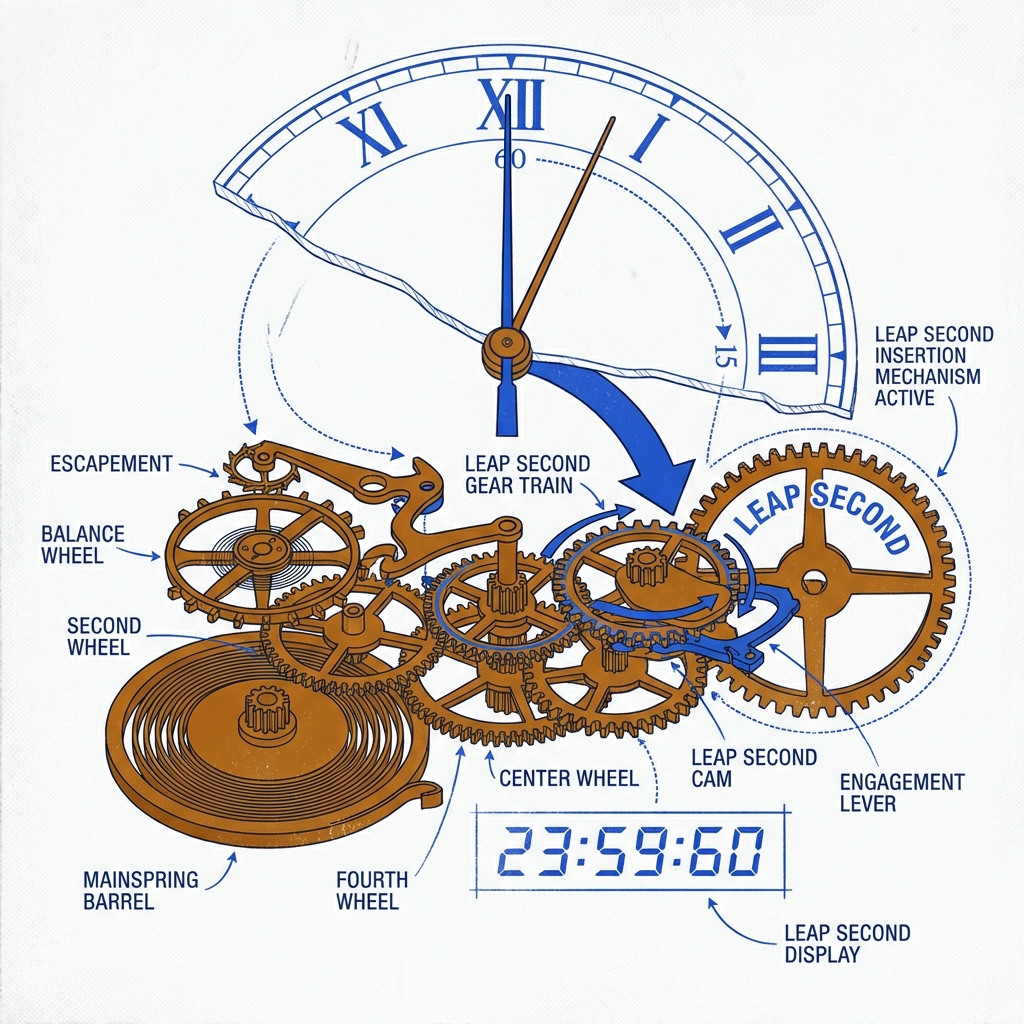
The problem is computers. Software generally assumes time moves forward in a steady, predictable way. A leap second—an extra 23:59:60 before midnight—violates that assumption. Systems can crash, restart, or behave unpredictably. In 2012, a leap second caused outages at Reddit, LinkedIn, and Qantas. Tech companies including Google and Meta have lobbied for years to abolish the practice.
In 2022, the General Conference on Weights and Measures voted to do exactly that. By 2035, no more leap seconds will be added. Atomic time and solar time will be allowed to drift apart, potentially by as much as a minute over the coming century, while scientists work out a less disruptive solution.
It's a strange trade-off: accepting that our clocks will gradually become wrong, because the cost of keeping them exactly right has become too high. The Earth keeps slowing. The atoms keep oscillating. Time, it turns out, is a matter of negotiation.
Filed under Modern Times, Inventions, ScienceFurther reading: Wikipedia
Print it for the office looPick your next sheet
Judge a story by its emoji. No peeking at titles.