Why Wombat Poop Is Cube-Shaped
Of all the animals on Earth, only the wombat produces cube-shaped feces. Each day, a bare-nosed wombat deposits roughly a hundred six-sided droppings across its territory. For years, nobody could explain how a soft intestine could manufacture something with corners.
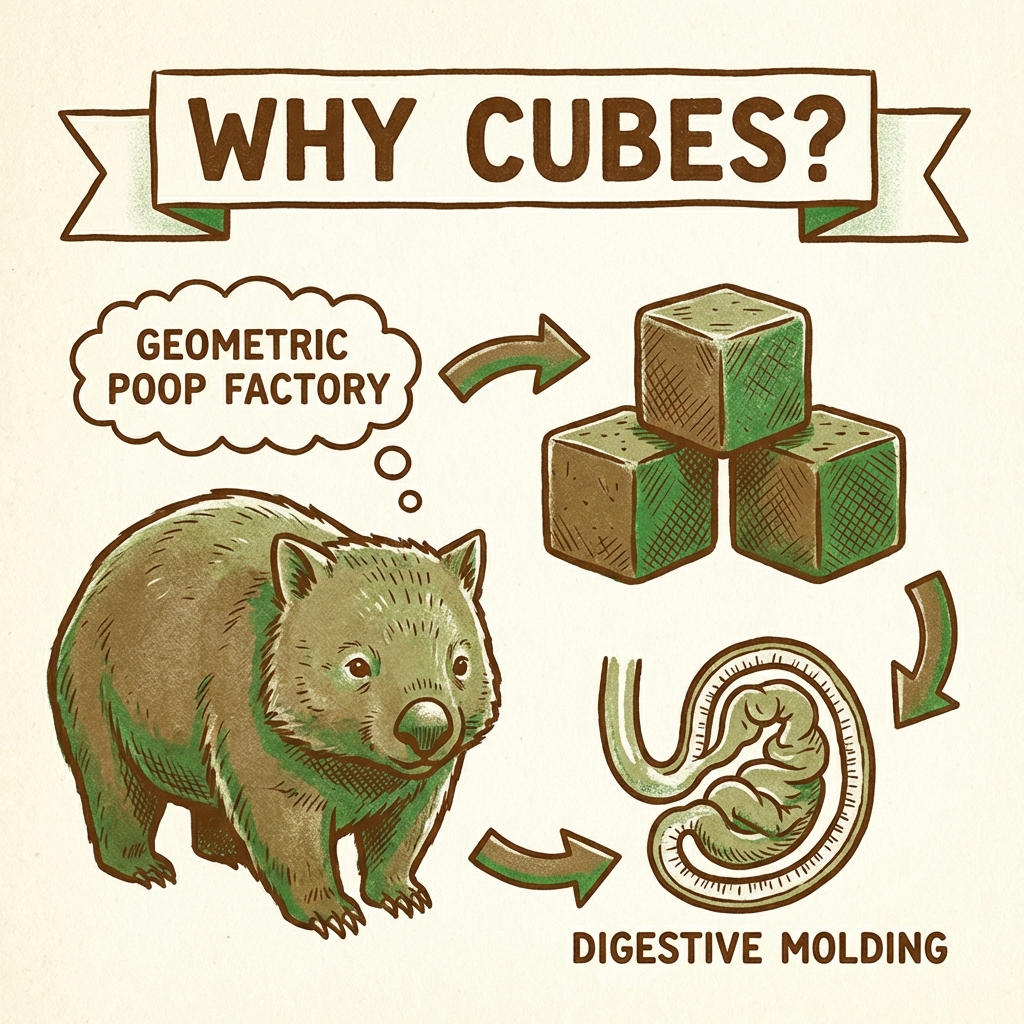
The answer turned out to involve an unusually long gut and some very specific muscle contractions. A wombat's intestine stretches about 32 feet—roughly ten times the length of its body—and digestion takes three to four times longer than in humans. By the time food reaches the final stretch of the digestive tract, most of the water has been extracted, leaving behind material that's far drier and more compacted than typical mammal feces.
In 2018, researchers at Georgia Tech led by Patricia Yang got access to wombat intestines from animals that had been euthanized after vehicle strikes in Australia. They inflated the intestines with balloons to study their elasticity and discovered something unusual: the tissue wasn't uniform. Around the circumference of the intestine, there were two stiff regions and two flexible regions, arranged in a pattern.
As the digestive tract contracts rhythmically, the stiff sections squeeze faster and harder than the flexible ones. Over the course of about 40,000 contractions, these asymmetrical pressures sculpt the material into something with flat sides and defined edges. The cubes form gradually, their corners becoming more pronounced as they travel the final stretch toward exit.
The question of why wombats evolved this trait is somewhat easier to answer. Wombats mark their territory by depositing feces in communal areas called latrines, often on rocks, logs, or other prominent features of the landscape. A cube stays where you put it. A sphere rolls away. The shape makes the scent markers more stable and more visible, and researchers have found that wombats can distinguish individual chemical signatures in each other's droppings.
The discovery won the 2019 Ig Nobel Prize in physics—an award for science that makes people laugh, then think. It also demonstrated that cubes can be manufactured inside soft tubes, which had never been observed before.
Filed under Around the World, Modern Times, Animals & NatureFurther reading: Smithsonian Magazine
Print it for the office looPick your next sheet
Judge a story by its emoji. No peeking at titles.