The Mary Celeste
On December 4, 1872, the British ship Dei Gratia was sailing about 400 miles east of the Azores when her crew spotted another vessel drifting in the choppy Atlantic. The ship was the Mary Celeste, an American merchant brigantine that had left New York City nearly a month earlier bound for Genoa.
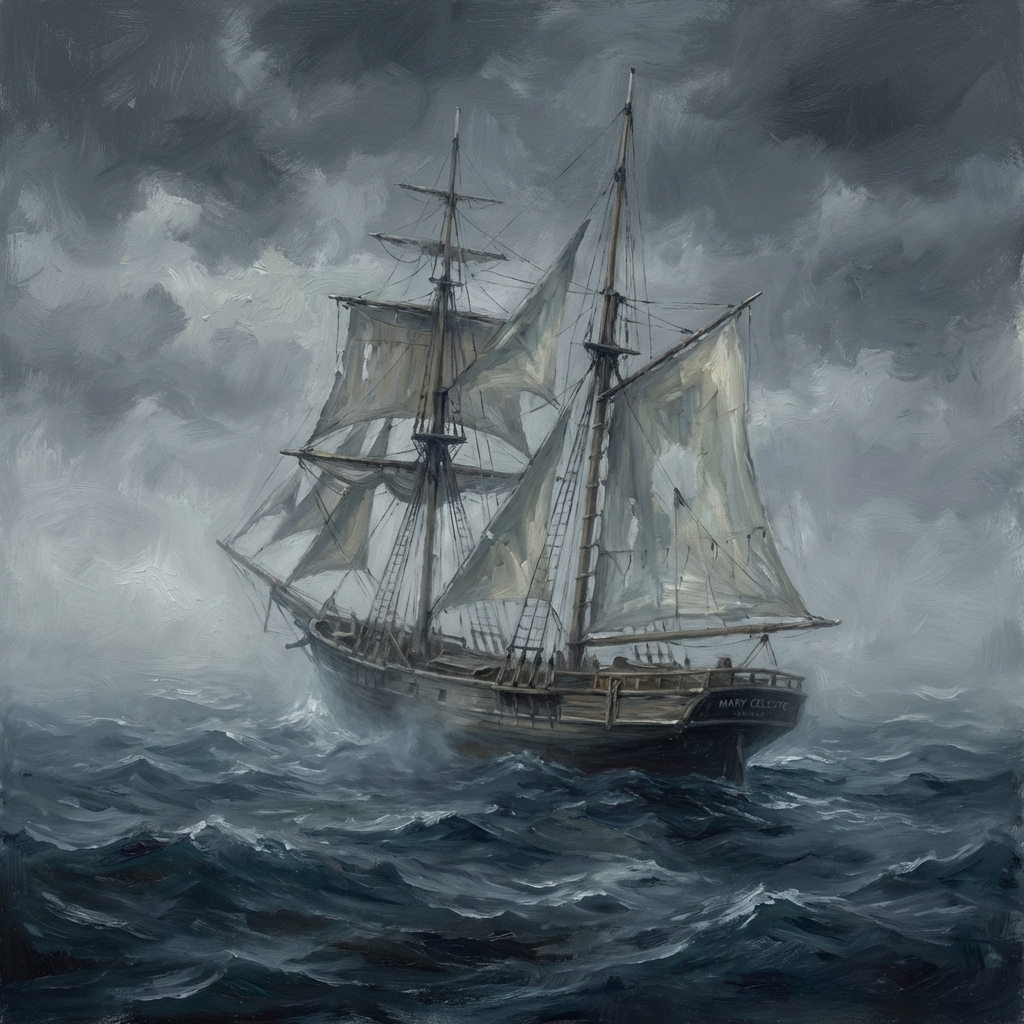
She should have arrived by now. Instead, she was adrift under partial sail, moving erratically through the water with no one at the helm.
A boarding party found the ship seaworthy but deserted. The cargo—1,701 barrels of denatured alcohol—was intact. The captain's and crew's personal belongings were undisturbed, including valuables that thieves would have taken. There was plenty of food and water. The ship's lifeboat was missing, along with the navigation equipment, but there were no signs of violence, no evidence of fire, and nothing to explain why anyone would abandon a perfectly functional vessel in the middle of the ocean.
Ten people had been aboard: Captain Benjamin Briggs, his wife Sarah, their two-year-old daughter Sophia, and a crew of seven. None of them were ever seen again. The last entry in the ship's log was dated ten days before the Dei Gratia found her.
British authorities investigated and found no evidence of foul play. The mystery generated theories for over a century. Some pointed to the alcohol cargo—nine of the barrels were empty, and Briggs might have feared an explosion from accumulating fumes. But the boarding party from the Dei Gratia reported no smell. Others suggested a waterspout or seaquake that caused the captain to panic and abandon ship prematurely. The most plausible reconstruction holds that Briggs ordered everyone into the lifeboat as a precaution, tethering it to the Mary Celeste with a rope, and that the line snapped during rough weather before they could reboard.
In 1884, Arthur Conan Doyle published a short story inspired by the case, misspelling the ship's name as Marie Celeste—an error that persisted in popular culture. The real Mary Celeste was deliberately wrecked off Haiti in 1885 as part of an insurance fraud.
Filed under Mysteries, The 1800s, Animals & NatureFurther reading: Wikipedia
Print it for the office looPick your next sheet
Judge a story by its emoji. No peeking at titles.