The Year Without a Summer
In April 1815, Mount Tambora on the Indonesian island of Sumbawa erupted with a force roughly four times that of Krakatoa.
The explosion blew the top 4,000 feet off the mountain, ejected approximately 36 cubic miles of rock into the atmosphere, and killed an estimated 10,000 people immediately. Tens of thousands more died in the following months from famine and disease. It was the largest volcanic eruption in recorded human history.
The full consequences, however, didn't arrive until the following year. The eruption had launched a massive cloud of sulfur dioxide into the stratosphere, where it formed an aerosol layer that reflected sunlight back into space. By the summer of 1816, global temperatures had dropped by an average of 0.4 to 0.7 degrees Celsius, enough to devastate agriculture across the Northern Hemisphere.
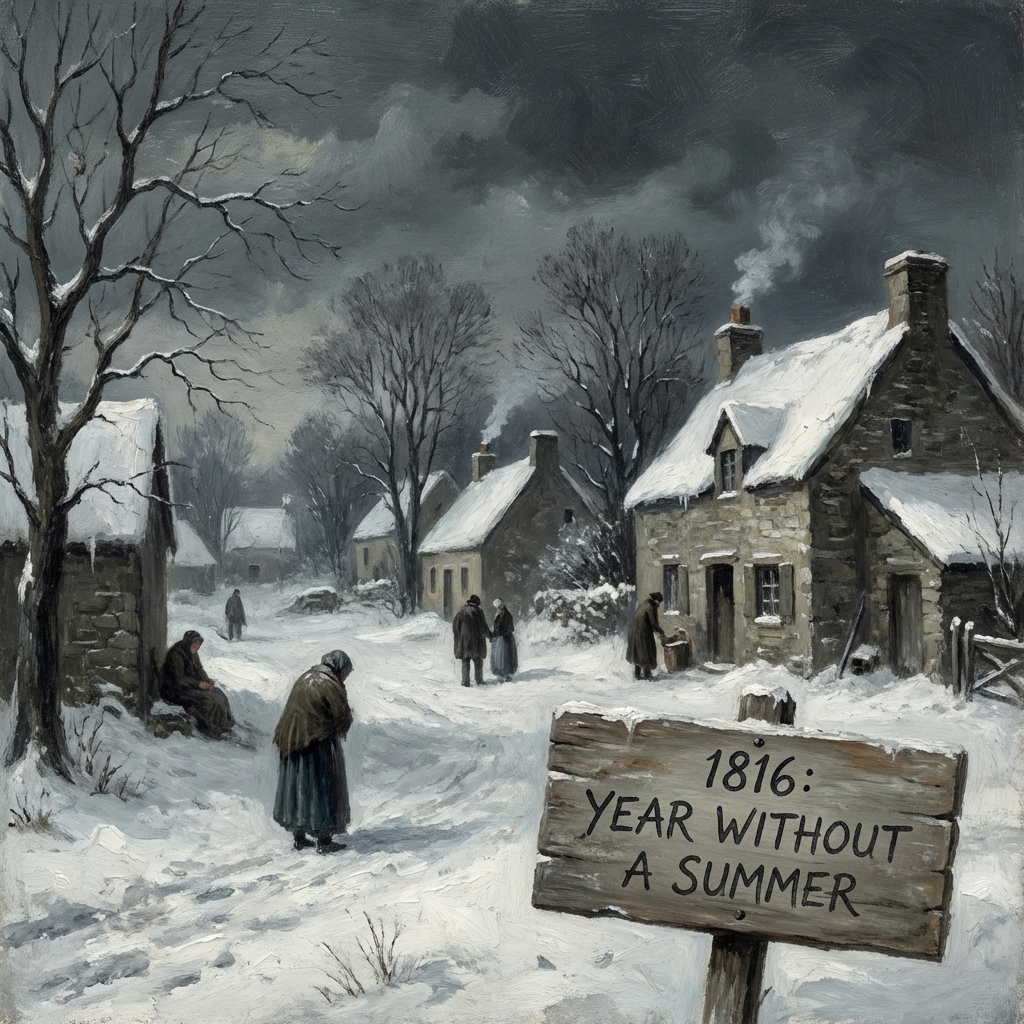
In New England, frost struck every month of the year. Snow fell in June across New York and Maine. Farmers in Vermont watched their crops wither and die repeatedly throughout what should have been the growing season. Grain prices surged across Europe, where the situation was even worse. Germany saw bread riots. Switzerland declared a national emergency. In Ireland, a cold and relentless rain destroyed the potato and oat harvests, triggering a famine and a typhus epidemic that killed 65,000 people.
The crisis reshaped the world in ways no one anticipated. Thousands of New England families, ruined by the failed harvests, abandoned their farms and migrated west, accelerating the settlement of the American frontier. In Germany, the grain shortage made oats for horses unaffordable, which reportedly motivated Karl Drais to invent the velocipede—an early ancestor of the bicycle—as an alternative to horseback travel.
The summer of 1816 also produced one of literature's most famous evenings. Trapped indoors by cold rain at a villa on Lake Geneva, Mary Shelley, Lord Byron, and their companions challenged each other to write ghost stories. Shelley, then eighteen, began working on what would become *Frankenstein*.
Filed under Disasters & Drama, The 1800s, Animals & NatureFurther reading: Wikipedia
Print it for the office looPick your next sheet
Judge a story by its emoji. No peeking at titles.