The Bloop
In the summer of 1997, hydrophones operated by the National Oceanic and Atmospheric Administration picked up an unusual sound in the South Pacific.
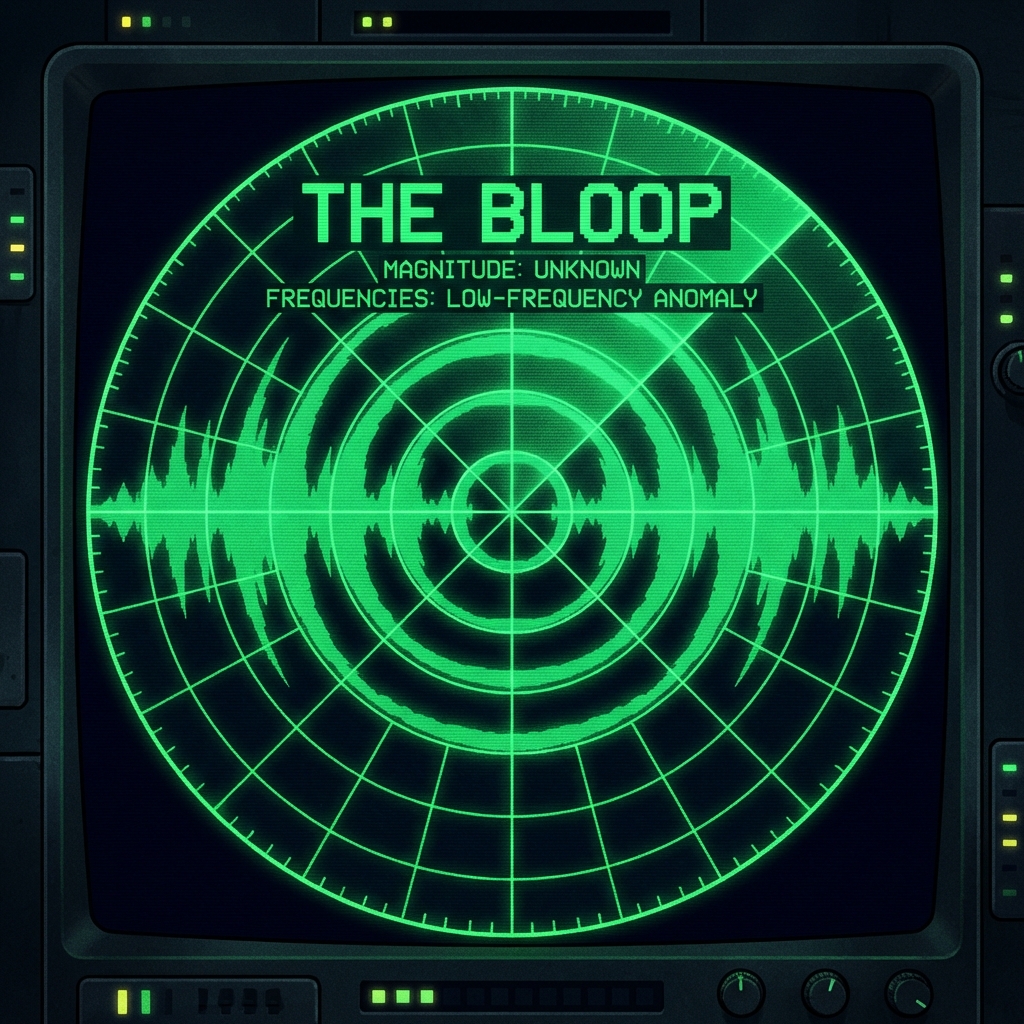
It was an ultra-low-frequency noise, powerful enough to be detected by sensors more than 3,000 miles apart. The signal rose rapidly in frequency over about one minute, then stopped. Researchers at NOAA's Pacific Marine Environmental Laboratory catalogued it and gave it a name: the Bloop.
The hydrophone array that captured the sound had originally been deployed by the U.S. Navy during the Cold War to track Soviet submarines. After the program was declassified in 1991, NOAA repurposed the equipment to monitor seismic activity and marine acoustics. The deep ocean turned out to be far noisier than anyone expected, full of sounds from volcanic activity, ice movement, shipping traffic, and marine life. Most of these could be identified. The Bloop could not.
What drew attention was the sound's profile. Its amplitude was several times louder than the loudest known biological sound—the call of the blue whale. Some researchers noted that its audio characteristics resembled those of a living creature, which inevitably sparked speculation about an undiscovered deep-sea animal of enormous size. The coordinates of the sound's origin, roughly 50 degrees south latitude and 100 degrees west longitude, placed it in a remote stretch of the South Pacific not far from the fictional location of R'lyeh, the sunken city in H.P. Lovecraft's mythology. This coincidence delighted the internet.
NOAA eventually determined that the Bloop was almost certainly an icequake—a large-scale fracture event in an Antarctic ice shelf. As glaciers crack, calve, and grind against rock, they produce sounds that propagate vast distances through the ocean. When researchers compared the Bloop to known icequake recordings, the match was strong. The agency published its conclusion in 2012.
The explanation satisfied most scientists but didn't entirely extinguish the mystery's appeal. NOAA's own hydrophone program has since recorded other unexplained sounds—Julia, Slowdown, Upsweep—each named and filed, most eventually attributed to ice or geological activity. The deep ocean remains one of the least explored environments on the planet, and the sounds it produces are still only partially understood.
Filed under Mysteries, Animals & Nature, ScienceFurther reading: Wikipedia
Print it for the office looPick your next sheet
Judge a story by its emoji. No peeking at titles.