Why Honey Never Spoils
When archaeologists opened tombs in Egypt, they found jars of honey sealed thousands of years ago that were still perfectly edible.
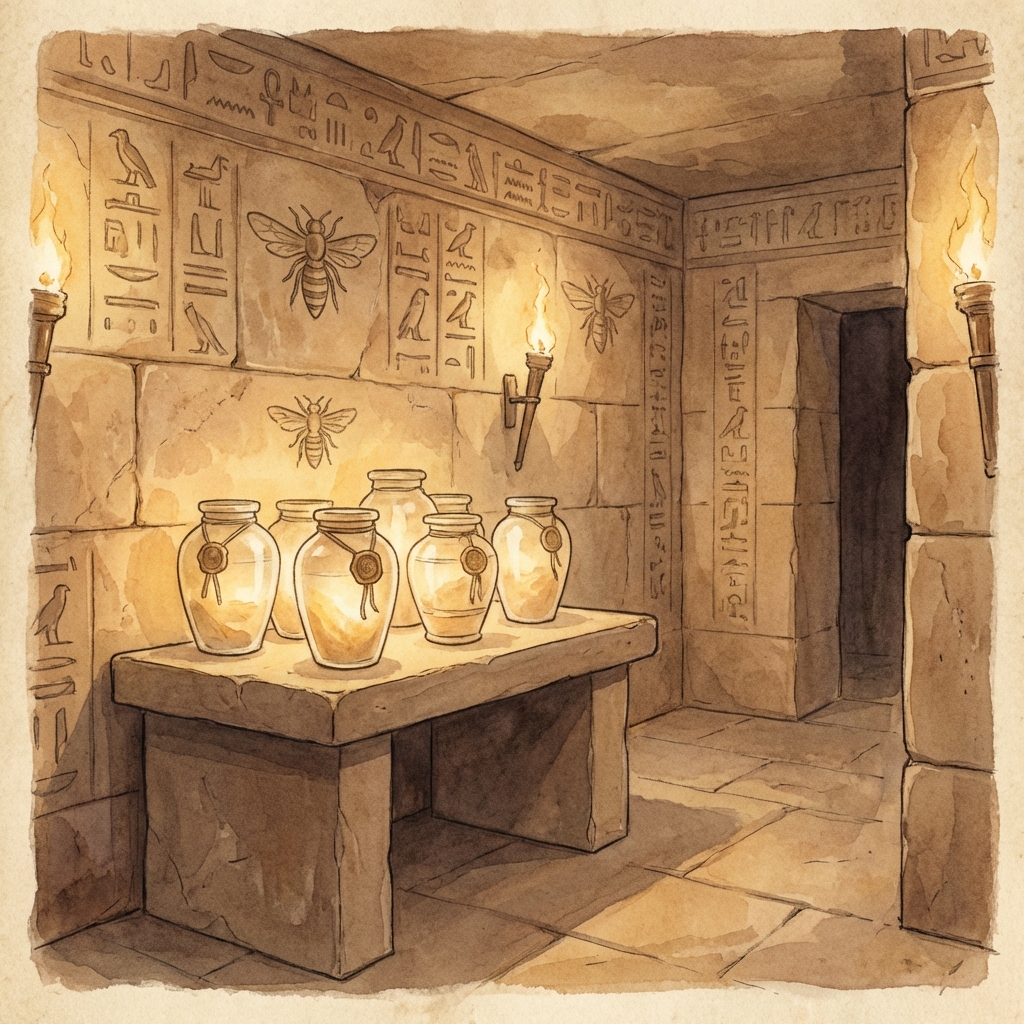
Honey is the only food known to have a truly indefinite shelf life, and the reasons involve chemistry that bees figured out long before humans understood it.
The first factor is moisture. Nectar, the raw material bees collect from flowers, contains 60 to 80 percent water. Bees reduce this dramatically by fanning their wings over the honeycomb, essentially dehydrating the nectar until it reaches about 15 to 18 percent moisture. At this concentration, the sugar content becomes so high—around 80 percent—that bacteria and fungi simply cannot survive. Any microorganism that lands in honey has the water pulled out of its cells through osmosis, killing it before it can reproduce.
But bees add something else. An enzyme called glucose oxidase exists in their stomachs. When bees regurgitate nectar into the comb, this enzyme breaks down the sugars and produces two byproducts: gluconic acid and hydrogen peroxide. The hydrogen peroxide acts as an antiseptic, while the gluconic acid makes honey slightly acidic, with a pH between 3 and 4.5. Very few pathogens can survive in such an environment.
Ancient Egyptians recognized honey's preservative properties without understanding the chemistry behind them. They used it to dress wounds and treat skin infections, creating ointments that prevented bacterial growth on injuries. They also incorporated honey into their mummification process, applying it to preserve bodies. The same properties that keep honey from spoiling helped slow the decay of human remains.
The catch is that honey must remain sealed. If moisture gets in, the water content rises enough to allow fermentation. This is actually how mead, one of humanity's oldest alcoholic beverages, is made—honey diluted with water and allowed to ferment. But as long as honey stays properly sealed in a dry environment, nothing will grow in it.
Modern science has confirmed what Egyptian embalmers knew empirically: honey is essentially self-preserving, a natural antiseptic that bacteria cannot colonize.
Filed under Food, Before 1800, Animals & NatureFurther reading: Smithsonian Magazine
Print it for the office looPick your next sheet
Judge a story by its emoji. No peeking at titles.