How Traffic Lights Were Invented Before Cars
The first traffic light was installed outside the Houses of Parliament in London on December 10, 1868—more than a decade before Karl Benz patented his motorcar. It was built to manage horse-drawn carriages, carts, and the growing number of pedestrians crossing Bridge Street, one of the busiest intersections in the city.
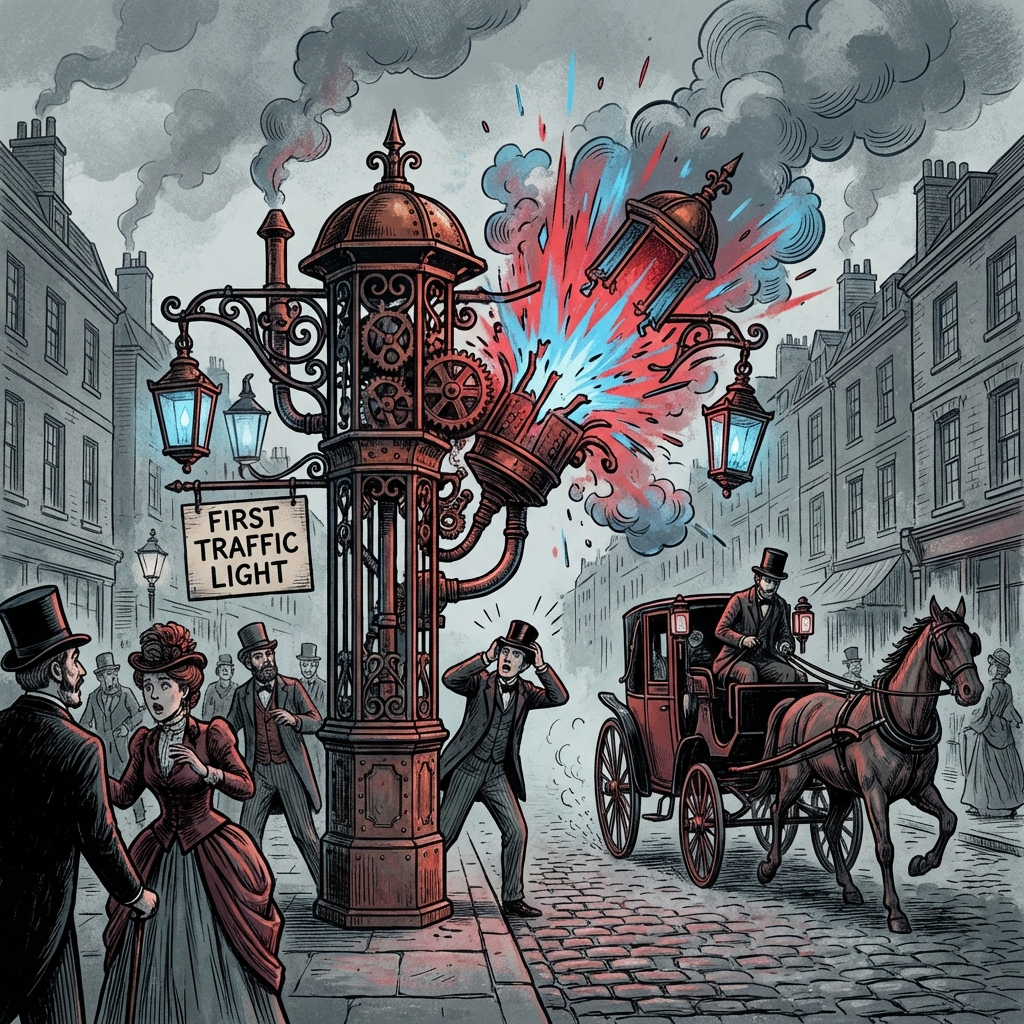
The device was designed by John Peake Knight, a railway engineer who adapted the semaphore signals already used on train lines. During the day, it operated mechanically: a police officer manually turned the signal arms to indicate "stop" or "caution." At night, it used red and green gas lamps, colors borrowed from maritime and rail conventions where red already meant danger and green meant clear.
The system worked for about a month. On January 2, 1869, the gas lamp leaked, and the resulting explosion burned the police officer operating it. London immediately abandoned the experiment. Traffic lights would not return to British streets for over fifty years.
The modern electric traffic light emerged in the United States in the early 1900s, driven by a different crisis: the automobile. As cars, horses, trolleys, and pedestrians competed for space on American streets, intersections became genuinely dangerous. In 1914, the American Traffic Signal Company installed the first electric signal at the corner of East 105th Street and Euclid Avenue in Cleveland, Ohio. It had red and green lights and a buzzer.
A Detroit police officer named William Potts is credited with adding the yellow light in 1920, solving the problem of what to do in the gap between stop and go. Potts had studied electrical engineering and built his three-color signal from railroad lights and about $37 worth of wire and equipment.
Garrett Morgan, an African American inventor and businessman, patented a different three-position signal in 1923 that included a "warning" position. Morgan later sold the patent to General Electric for $40,000. He was also the inventor of an early gas mask used by firefighters, and one of the first African American men in Cleveland to own an automobile.
Filed under The 1800s, Inventions, QuirkyFurther reading: Wikipedia
Print it for the office looPick your next sheet
Judge a story by its emoji. No peeking at titles.