Why Bananas Are Radioactive
Every banana you eat exposes you to a tiny amount of radiation. This isn't a concern—it's barely measurable—but it's real enough that nuclear scientists have turned it into an informal unit of measurement. The "banana equivalent dose" compares radiation exposure to the amount you'd receive from eating a single banana, about 0.1 microsieverts.
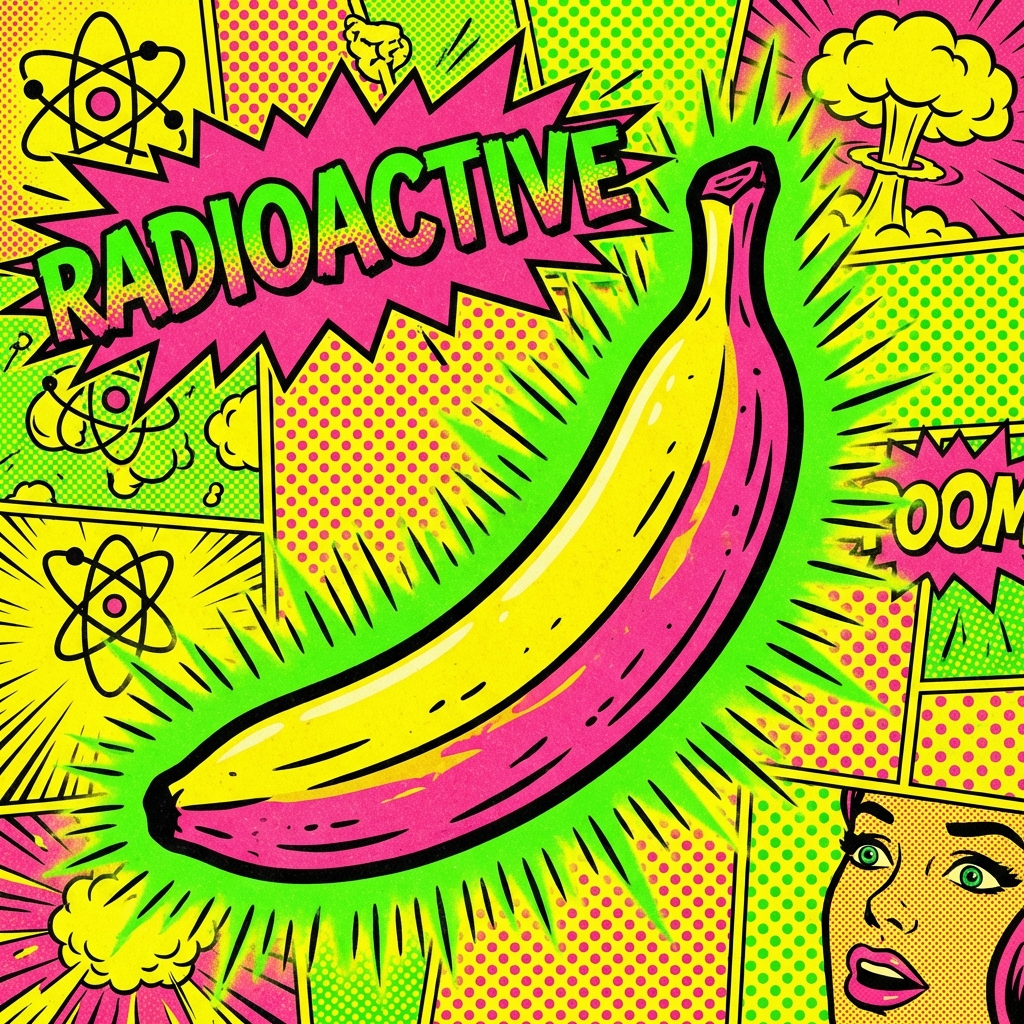
The radiation comes from potassium-40, a naturally occurring radioactive isotope of potassium. Bananas are rich in potassium, which is why they're recommended for muscle cramps and heart health. About 0.012 percent of all natural potassium is the radioactive isotope, and since a medium banana contains roughly 450 milligrams of potassium, each fruit delivers approximately 15 becquerels of radioactivity.
To put that in perspective: a chest X-ray delivers about 100 microsieverts, equivalent to eating roughly 1,000 bananas at once. A cross-country flight exposes you to about 40 microsieverts from cosmic radiation, or 400 banana equivalents. Living within 50 miles of a nuclear power plant for a year adds about 0.09 microsieverts—less than one banana.
The banana equivalent dose was popularized in the 1990s as a way to communicate radiation risk to a public conditioned to fear any mention of the word "radioactive." It works because it's intuitive. When someone hears that a medical scan delivers 10,000 microsieverts, the number is abstract. Saying it's equivalent to eating 100,000 bananas makes the comparison tangible, if slightly absurd.
There is a genuine scientific nuance, though. The body tightly regulates its potassium levels. When you eat a banana, your kidneys excrete excess potassium relatively quickly, so the radioactive load doesn't accumulate the way it would with, say, cesium-137, which the body absorbs and retains. This means you can't actually give yourself radiation poisoning by eating bananas, no matter how many—your body would reject the excess potassium long before the radiation became relevant.
Other common foods are radioactive too. Brazil nuts, lima beans, potatoes, and carrots all contain potassium-40. Brazil nuts are actually more radioactive than bananas, thanks to radium absorbed from the soil. But "brazil nut equivalent dose" doesn't have the same ring.
Filed under Food, Animals & Nature, ScienceFurther reading: Wikipedia
Print it for the office looPick your next sheet
Judge a story by its emoji. No peeking at titles.