The Sailing Stones of Death Valley
In a remote corner of Death Valley, rocks move by themselves.
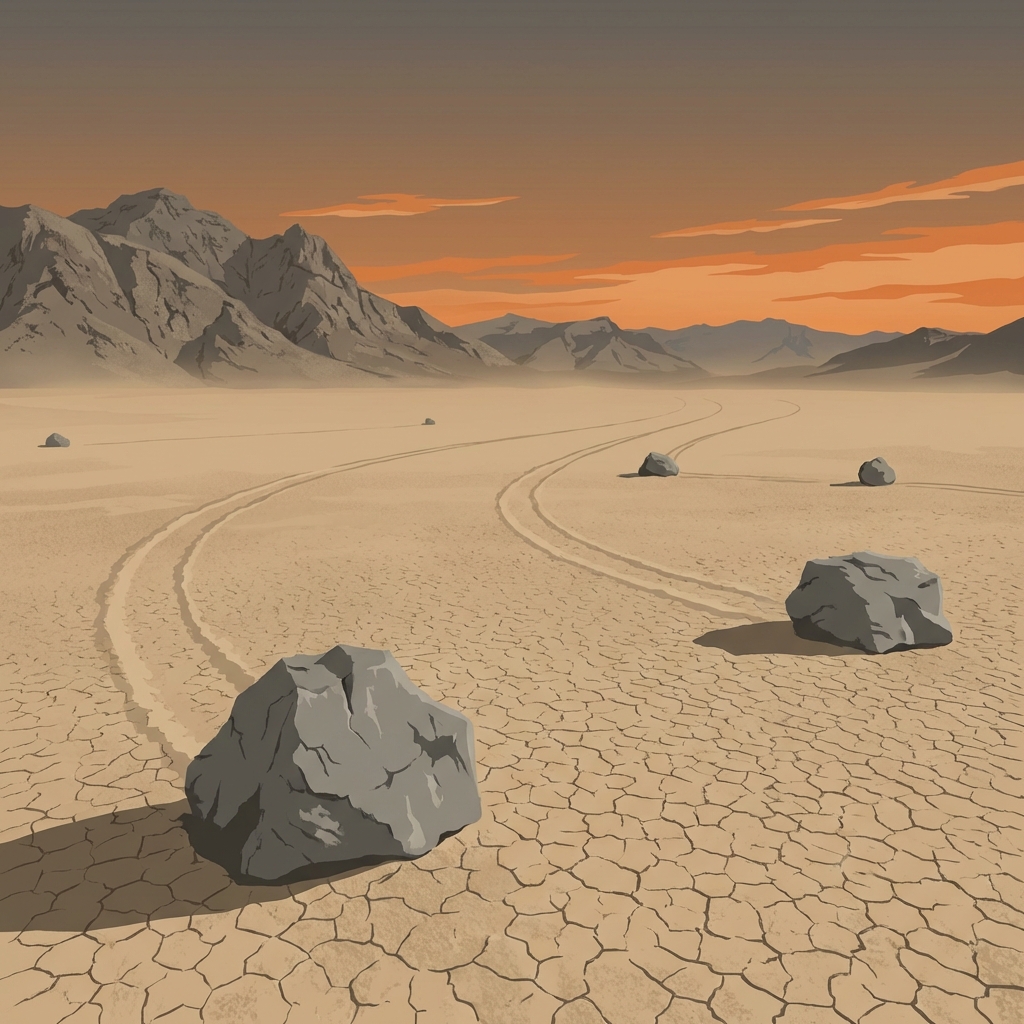
They leave long tracks in the dried mud of Racetrack Playa, a flat lake bed that's been dry for thousands of years. Some trails stretch hundreds of feet. Some curve. Some run parallel, then diverge. For decades, no one could explain how stones weighing up to 700 pounds were sliding across a perfectly flat surface with no apparent force moving them.
The phenomenon was first documented in the early 1900s and became a genuine scientific curiosity by mid-century. Geologists proposed wind, flooding, earthquakes, algae, and magnetic fields. Some theories required sustained winds of over 100 miles per hour—plausible in theory but never observed at the site. Others suggested that the playa occasionally flooded and the rocks were pushed by sheets of ice, but no one had ever seen it happen. The stones moved so infrequently and unpredictably that simply watching them was impractical.
In 2011, a team led by Richard Norris and his cousin Jim Norris, both researchers, set up a monitoring station on the playa. They installed GPS units on 15 rocks and placed a weather station at the site. Then they waited. For two years, nothing happened.
In December 2013, the Norrises visited the playa and witnessed the stones moving for the first time in recorded history. The mechanism turned out to be a specific sequence of conditions. First, the playa floods with a thin layer of water, just a few inches deep. Overnight, the water freezes into a thin sheet of ice. As the morning sun hits the ice, it begins to break into large, thin panels. Light winds push these panels across the water's surface, and the ice sheets shove the rocks ahead of them. The force required is minimal—the rocks are essentially floating on a layer of wet mud, and ice panels the size of football fields can push them at speeds of a few inches per second.
The team published their findings in 2014. The solution was elegant—a rare convergence of water, cold, ice, sun, and wind, occurring only a handful of times per decade, in a place almost nobody visits.
Filed under Mysteries, Modern Times, Animals & NatureFurther reading: Wikipedia
Print it for the office looPick your next sheet
Judge a story by its emoji. No peeking at titles.