How the Guillotine Was Designed to Be Humane
Before the French Revolution, the method of execution in France depended on social class. Nobles were beheaded by sword, a relatively quick death if the executioner was skilled. Commoners were hanged, broken on the wheel, or burned. These methods were often slow, unreliable, and public in ways designed to maximize suffering as a deterrent.
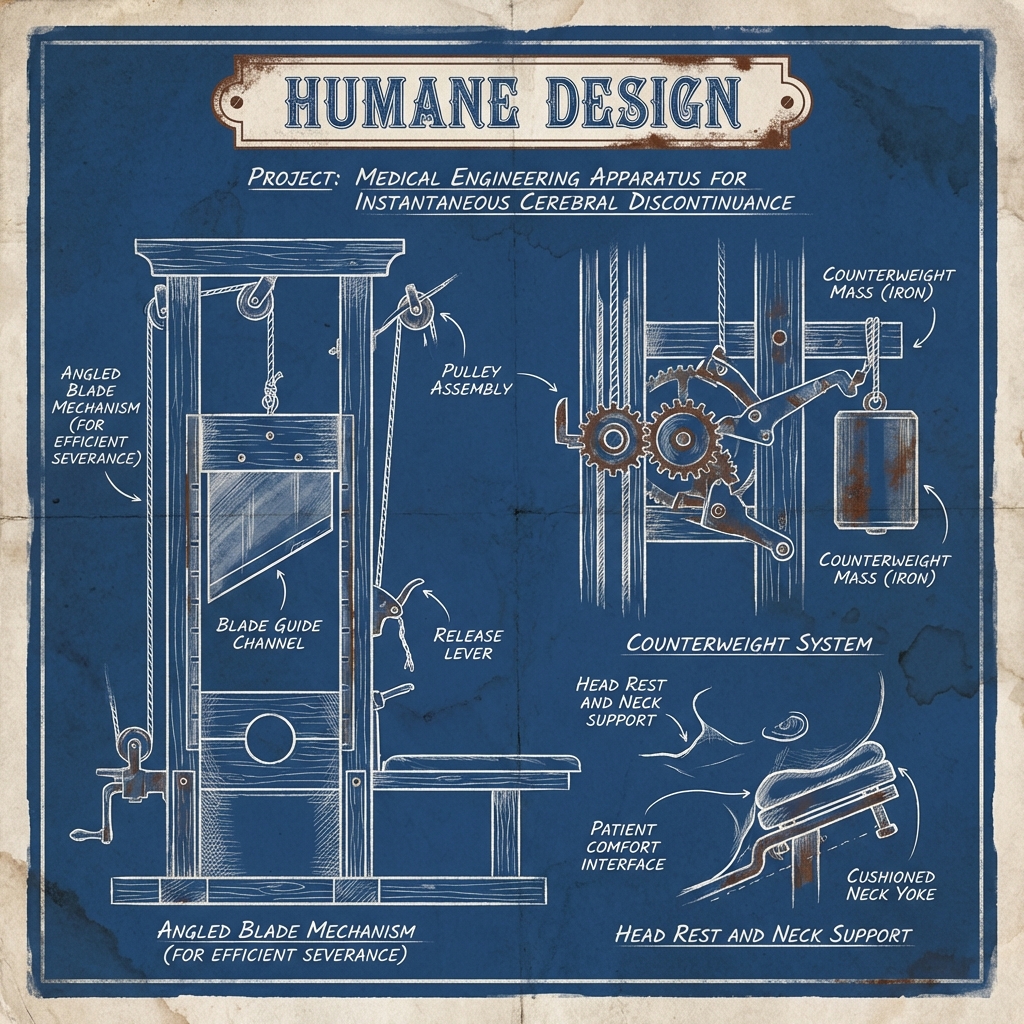
In 1789, Joseph-Ignace Guillotin, a physician and member of the National Assembly, proposed that all executions should be performed by a single, painless method applied equally regardless of class. His argument wasn't against the death penalty—he accepted it as a legal reality—but against the cruelty and inequality of its administration. He advocated for a mechanical decapitation device that would make execution instant and democratic. Equal citizens, he reasoned, deserved equal deaths.
Guillotin didn't design the machine. The actual engineering was done by Antoine Louis, the secretary of the Academy of Surgery, and Tobias Schmidt, a German harpsichord maker who built the prototype. Louis designed the angled blade—earlier versions used a straight, crescent-shaped edge, but testing on cadavers showed that an oblique blade cut more reliably. Schmidt constructed it for 960 livres, undercutting a rival bid. The first execution took place on April 25, 1792, when a highwayman named Nicolas Pelletier was beheaded in front of the Hôtel de Ville in Paris.
The device worked exactly as intended. The blade fell, and death appeared to be instantaneous. Observers reportedly found it disappointing—too fast, too clean. "Give me back my wooden gallows," one crowd member is said to have complained.
Within a year, the device became the Revolution's signature instrument. During the Reign of Terror, between September 1793 and July 1794, roughly 17,000 people were guillotined across France, including Louis XVI and Marie Antoinette. The machine designed to eliminate cruelty became the icon of industrialized killing.
Guillotin himself was horrified by the association and spent his later years trying to distance himself from the device. His family petitioned the French government after his death in 1814 to change the machine's name. The government refused. The family changed their surname instead.
Filed under Before 1800, Inventions, QuirkyFurther reading: Wikipedia
Print it for the office looPick your next sheet
Judge a story by its emoji. No peeking at titles.