The Great Stork Derby
When Charles Vance Millar died in Toronto on October 31, 1929, his will contained a clause that would consume the city's attention for a decade. Millar, a wealthy and childless lawyer with a well-documented sense of humor, left the bulk of his estate to whichever Toronto woman gave birth to the most children in the ten years following his death.
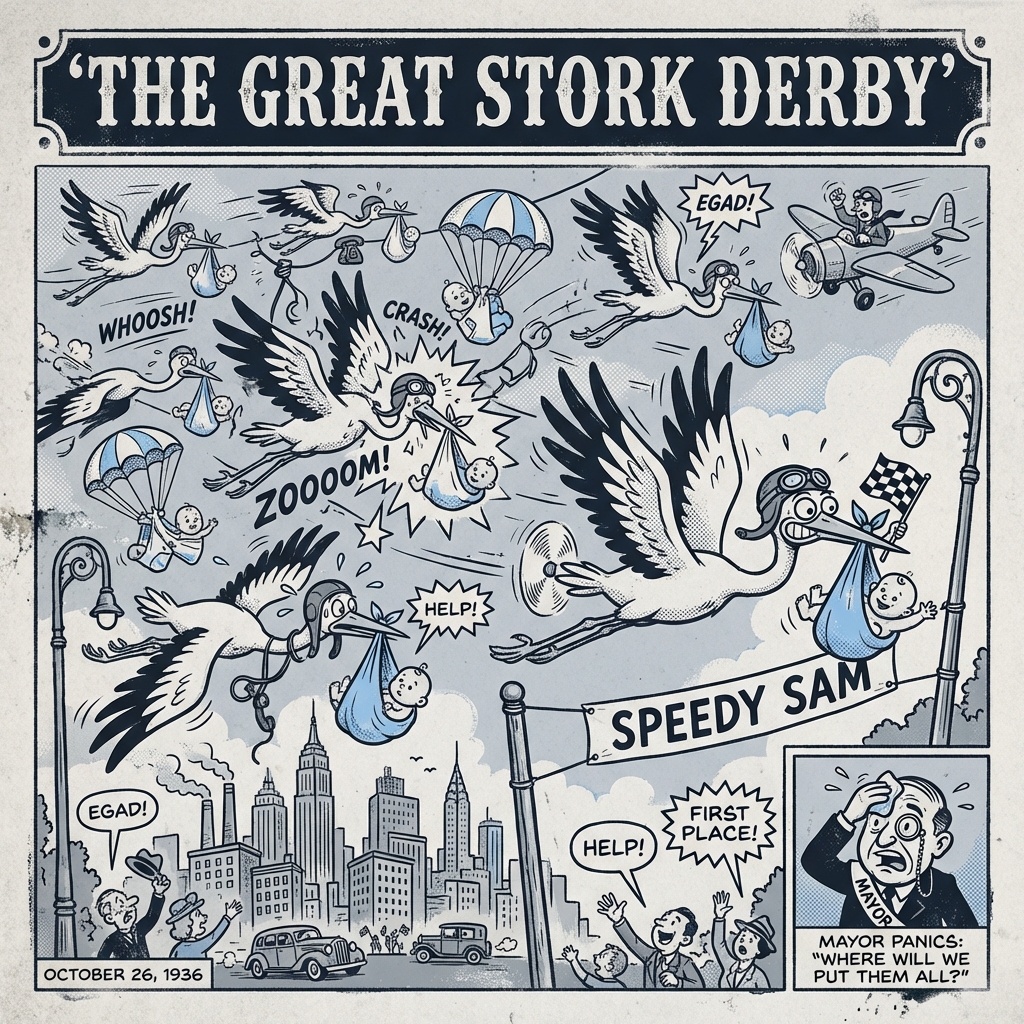
The clause was deliberate provocation. Millar had spent his life crafting mischievous legal documents, and this was his masterpiece. He also left shares in a jockey club to two prominent anti-gambling ministers, and shares in a Catholic brewery to a group of Protestant temperance advocates. But the baby clause was the one that captured the public imagination, especially because it coincided almost exactly with the Great Depression.
For families struggling through the worst economic crisis in modern history, the prospect of inheriting Millar's estate—which grew to roughly $750,000 by 1936, equivalent to about $16 million today—was transformative. Women across Toronto began having children at extraordinary rates. Newspapers tracked the standings. Reporters visited homes. The competition, which the press nicknamed the "Great Stork Derby," became one of the most closely followed stories in Canada.
Several legal challenges tried to overturn the clause. The Ontario government argued it was against public policy and morals. Millar's distant relatives contested the will. A group of Toronto mothers even petitioned the court to distribute the money early. All challenges failed. The courts ruled that however eccentric, the clause was legally valid, and Millar had been of sound mind.
When the deadline arrived on October 31, 1938, four women tied with nine children each. Each received roughly $125,000—a fortune during the Depression. Two additional women who had been disqualified on technicalities (one had children by more than one father, the other included stillbirths in her count) received $12,500 consolation payments from the estate.
Millar's joke had lasted a decade and produced, by one estimate, at least thirty-six children whose births were directly motivated by a dead man's sense of humor.
Filed under Around the World, Culture & Words, QuirkyFurther reading: Wikipedia
Print it for the office looPick your next sheet
Judge a story by its emoji. No peeking at titles.