Why We Have Fingerprints
The most common explanation for why humans have fingerprints is grip—the ridges on our fingertips supposedly help us hold onto objects, the way tire treads grip wet roads. It sounds intuitive. It's also probably wrong.
In 2009, researchers at the University of Manchester tested the grip hypothesis by having volunteers press their fingers against acrylic surfaces at various angles and forces. They found that fingerprints actually reduced friction compared to smooth skin. The ridges decreased the total contact area between finger and surface, which meant less grip, not more. If fingerprints evolved for holding things, they were doing a poor job of it.
A more promising theory involves touch sensitivity. In 2021, a study published in the Journal of Neuroscience found that fingerprint ridges amplify vibrations when a finger slides across a textured surface. The ridges convert spatial patterns—like the weave of fabric or the grain of wood—into vibrations at specific frequencies that happen to match the optimal sensitivity range of Pacinian corpuscles, the nerve endings deep in the skin that detect fine texture. Fingerprints, in this model, are essentially biological amplifiers that let us feel detail that smooth skin would miss.
Other researchers have proposed that the ridges help channel moisture away from the fingertips, preventing hydroplaning during wet grip—similar to the channels in a car tire rather than the treads themselves. This would explain why fingers wrinkle in water, another long-standing mystery. The wrinkling may not be passive swelling but an active response by the nervous system to improve drainage.
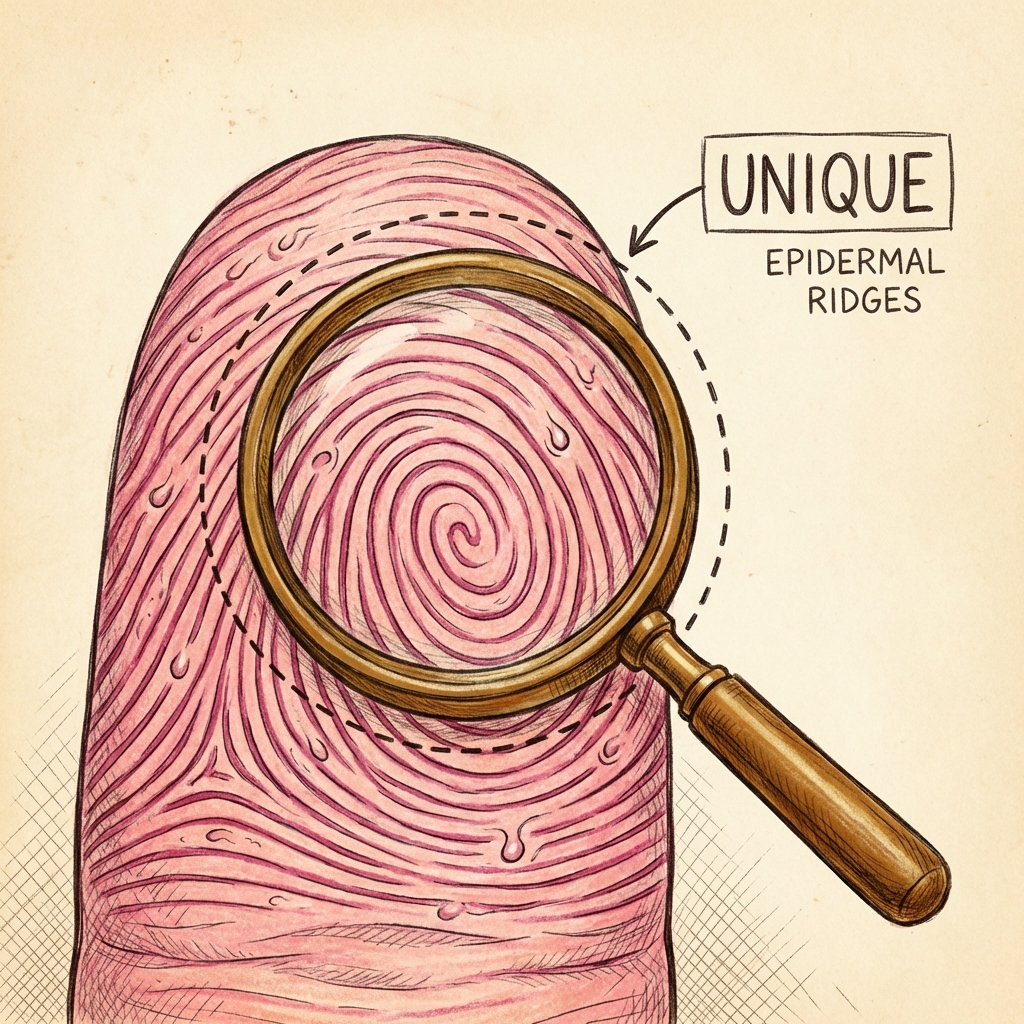
There's also the fact that fingerprints are unique. No two people share the same pattern, and even identical twins have different prints. This uniqueness has no evolutionary function that anyone has identified—it appears to be a byproduct of the random mechanical stresses each fetus experiences during development, when friction ridges form between weeks 10 and 17 of gestation.
The ridges are only about a tenth of a millimeter deep, but they've anchored an entire field of forensic science and spawned decades of biological debate. What they're actually for remains, in the precise scientific sense, an open question.
Filed under Modern Times, ScienceFurther reading: Wikipedia
Print it for the office looPick your next sheet
Judge a story by its emoji. No peeking at titles.