Why the Sea Is Salty
Rivers carry salt to the ocean. They've been doing it for billions of years.
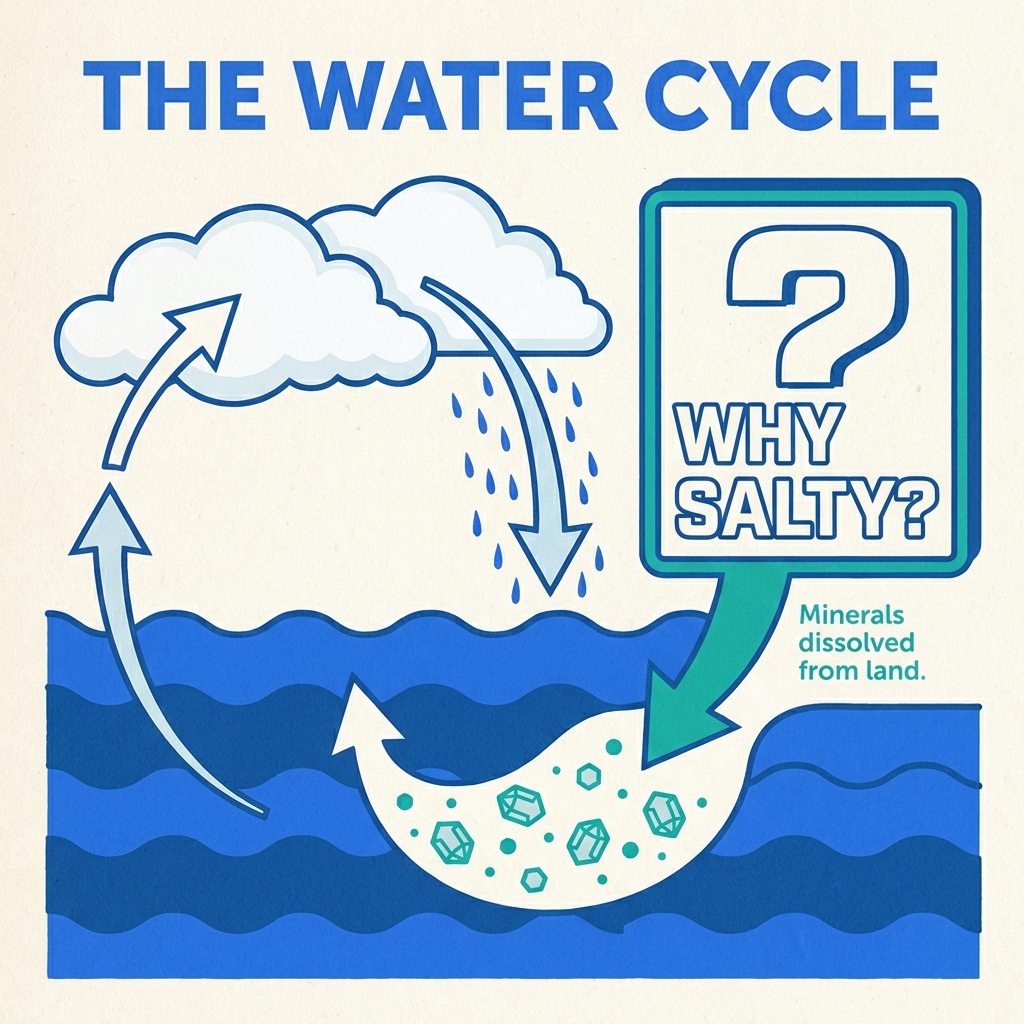
All water that flows over land picks up trace minerals from the rocks and soil it touches. These minerals include sodium, chloride, calcium, magnesium, and sulfate—the components of salinity. Each individual river carries only a tiny concentration. The Mississippi, for instance, delivers about 145 million tons of dissolved minerals to the Gulf of Mexico each year, but at any given point the water tastes perfectly fresh. The concentration is too low to detect.
The ocean is different because it's a terminal basin. Water flows in from rivers, but the only way water leaves the ocean is through evaporation—and evaporation leaves the salt behind. Over geological time, this one-way process has concentrated the ocean's mineral content to about 3.5 percent by weight, or roughly 35 grams of salt per liter. A single cubic mile of seawater contains approximately 120 million tons of dissolved sodium chloride.
Lakes aren't salty for the same reason rivers aren't: most lakes have an outlet. Water flows in, picks up and deposits minerals, and flows out, carrying excess salts downstream toward the ocean. The Great Lakes, for example, drain through the St. Lawrence River. Their water cycles through in about 200 years, never sitting still long enough to accumulate significant salinity.
Lakes without outlets do become salty. The Great Salt Lake in Utah, the Dead Sea, and the Caspian Sea are all endorheic—they collect water but have no river flowing out. Like the ocean, they concentrate minerals through evaporation. The Dead Sea is roughly ten times saltier than the ocean, at about 34 percent salinity, which is why swimmers float in it so effortlessly.
The ocean reached its current salinity hundreds of millions of years ago and has remained roughly stable since. The input of new salt from rivers is balanced by processes that remove it—salt deposits on the seafloor, chemical reactions at hydrothermal vents, and the formation of evaporite minerals in shallow basins. The system is in equilibrium, not still accumulating.
Filed under Animals & Nature, ScienceFurther reading: Wikipedia
Print it for the office looPick your next sheet
Judge a story by its emoji. No peeking at titles.