The Cobra Effect
During British colonial rule in India, the government in Delhi grew concerned about the number of venomous cobras in the city. The administration offered a bounty: bring in a dead cobra and receive a cash payment. The logic was straightforward—fewer cobras meant fewer snakebites, and a financial incentive would mobilize the population to hunt them.
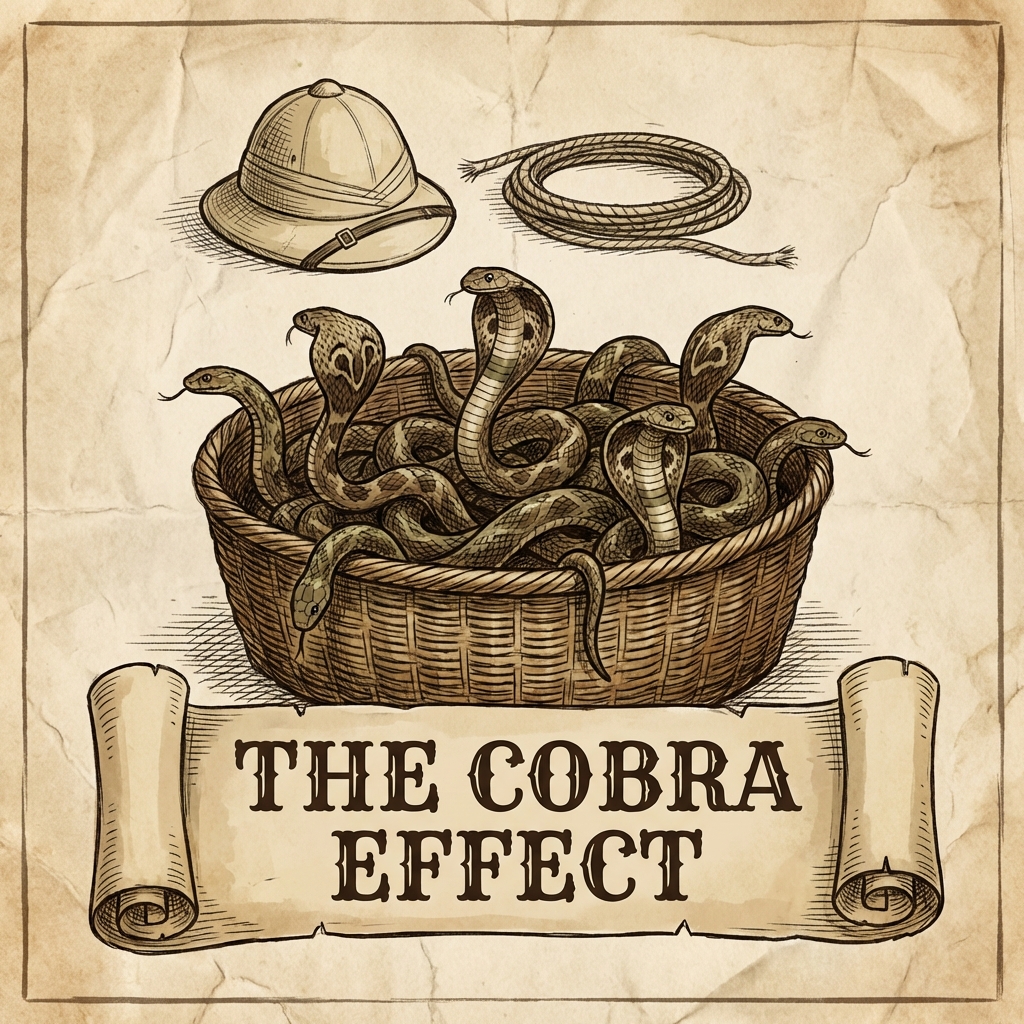
At first, the program worked. People killed cobras and collected bounties. The snake population appeared to decline. Then something shifted. Enterprising residents realized that breeding cobras was more profitable than hunting wild ones. Small cobra farms appeared across Delhi, producing snakes specifically to be killed and exchanged for bounty money. The government was now subsidizing cobra production.
When officials discovered what was happening, they canceled the bounty program. The cobra breeders, left with now-worthless snakes and no income stream, released their inventory into the streets. The cobra population ended up larger than before the program began.
The story, recounted by the economist Horst Siebert in his 2001 book *Der Kobra-Effekt*, gave the phenomenon its name. Whether the specific details of the Delhi cobra case are historically precise has been debated—the original colonial sources are thin—but the dynamic it describes is well documented across many contexts.
The French colonial government in Hanoi encountered the same problem with rats. In 1902, they offered a bounty for rat tails as proof of kills. Residents began catching rats, cutting off their tails, and releasing them alive to breed more rats. Others started farming rats outright. The rat population increased.
The pattern recurs whenever a reward creates an incentive to produce the very problem it was meant to solve. Paleontologists have noted that when fossil laws pay for dinosaur bone discoveries, fossils get broken into smaller pieces to increase the count. Some fire departments that paid per fire responded to saw an increase in arson.
Economists now use "cobra effect" as shorthand for any well-intentioned policy that worsens the problem it targets, usually because the policymakers assumed people would respond to the incentive in only one way.
Filed under Around the World, The 1800s, HistoryFurther reading: Wikipedia
Print it for the office looPick your next sheet
Judge a story by its emoji. No peeking at titles.