The Paris Catacombs
Beneath the streets of Paris lies a network of tunnels containing the remains of roughly six million people.
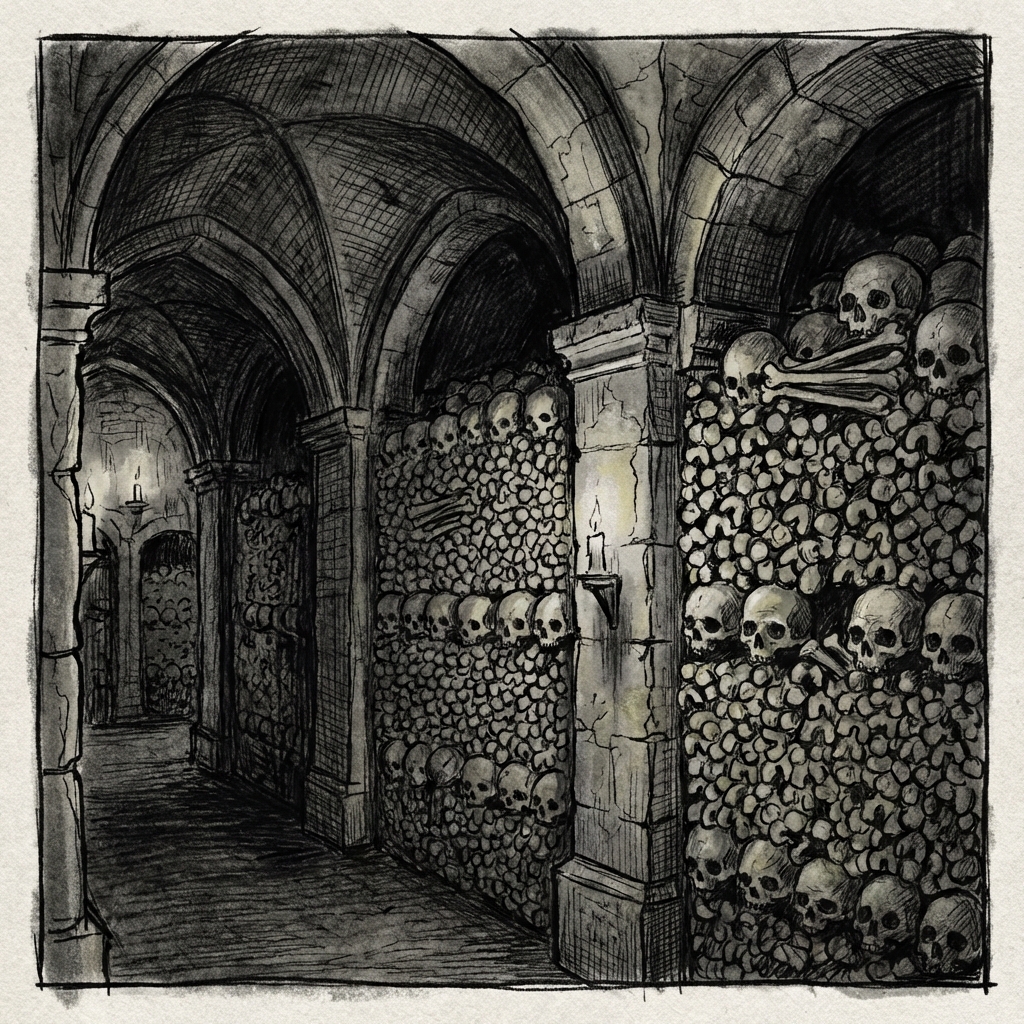
The bones are stacked floor to ceiling in carefully arranged walls—femurs laid horizontally, skulls placed in neat rows at regular intervals to create a repeating pattern. The arrangement is deliberate, almost decorative, and it stretches for more than a mile through the tunnels that are open to the public. The total tunnel network extends for nearly 200 miles.
The catacombs began as limestone quarries. Paris was built from stone pulled from beneath its own streets, and by the 18th century, the quarries riddled the ground under the Left Bank. The tunnels caused occasional building collapses—an entire street, the Rue d'Enfer, sank into a quarry void in 1774.
The bone problem was separate. By the late 1700s, Paris's cemeteries were catastrophically overcrowded. The largest, the Saints-Innocents cemetery near Les Halles, had been in continuous use for almost a thousand years. Bodies were buried in mass graves stacked ten deep. In 1780, the wall of a basement adjoining the cemetery collapsed, and an avalanche of corpses and mud poured into the building. The city shut the cemetery down.
Starting in 1786, workers began exhuming the remains and transporting them by cart—at night, to avoid public disturbance—to the abandoned quarries beneath the Montparnasse district. The transfer took two years for Saints-Innocents alone. Over the following decades, bones from most of Paris's other cemeteries were relocated as well. The project continued in stages until 1860.
The decorative arrangement of bones was the work of Louis-Étienne Héricart de Thury, who oversaw a renovation of the catacombs in 1810 and turned them into a macabre attraction. He organized the bones into walls, added plaques with philosophical inscriptions about mortality, and opened the space for public visits as early as 1809.
The catacombs remain open to tourists today, though only a small fraction is accessible. The rest of the tunnel network is off-limits and patrolled by a dedicated police unit, the cataflics, who enforce the ban on unauthorized entry.
Filed under Before 1800, Quirky, EuropeFurther reading: Wikipedia
Print it for the office looPick your next sheet
Judge a story by its emoji. No peeking at titles.