The Bridge That Soldiers Must Break Step On
On April 12, 1831, a column of the 60th Rifle Corps marched across Broughton Suspension Bridge near Manchester, England.
As the soldiers crossed in step, the bridge began to sway. The bolts on one side of the deck sheared, and the bridge dropped several feet, throwing soldiers against the railings and into the River Irwell below. Remarkably, nobody died, though about twenty soldiers were injured.
The cause was mechanical resonance. When people walk in unison, their synchronized footsteps create a rhythmic force. If the frequency of that rhythm happens to match the bridge's natural frequency of oscillation, the vibrations amplify rather than cancel out. Each step adds energy to the existing motion, and the oscillations can grow until the structure fails. It's the same principle that allows a singer to shatter a glass by matching its resonant frequency—except in this case, the "singer" was a regiment of infantrymen.
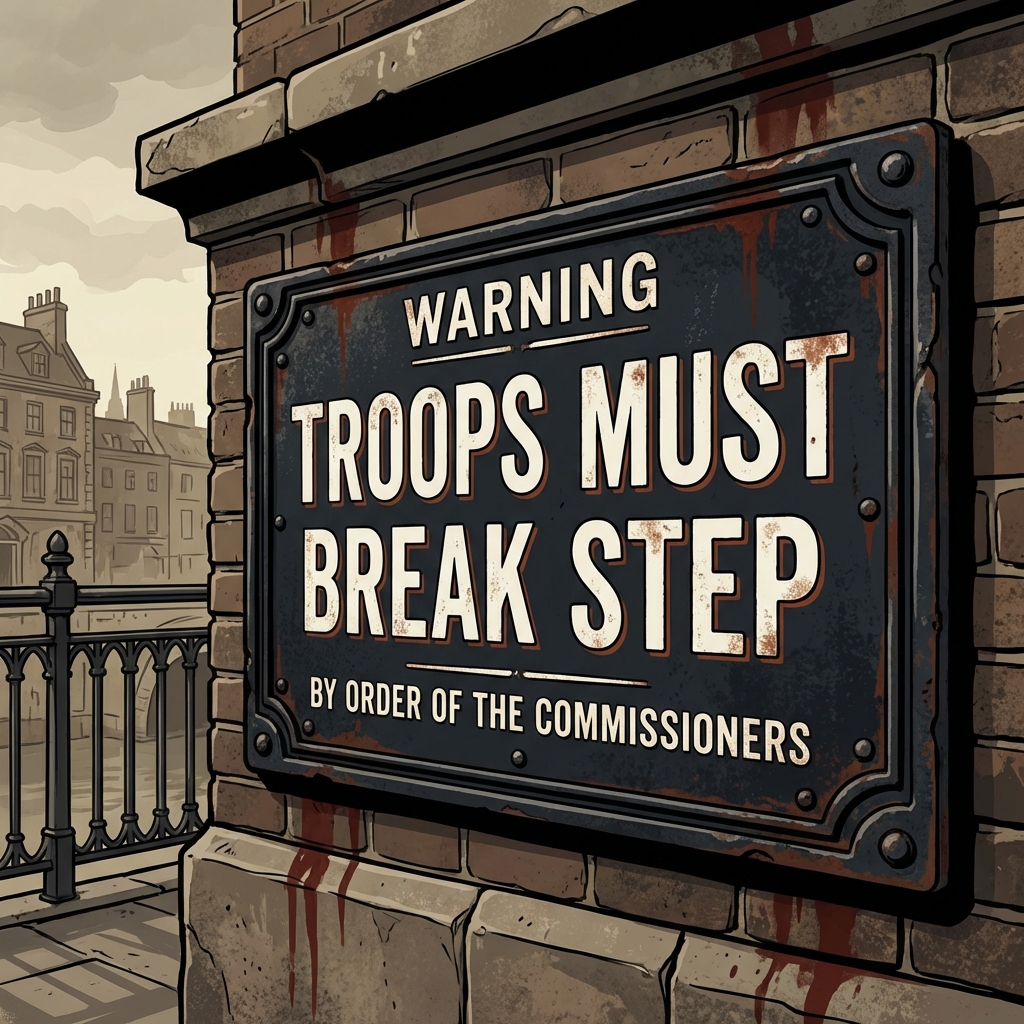
The Broughton collapse led to a standing order, still observed by the British military, that troops must break step when crossing a bridge. The command "break step" means soldiers stop marching in unison and walk at their own pace, which prevents the synchronized force from building up.
The principle was dramatically confirmed in 2000, when the Millennium Bridge in London opened and immediately began swaying under pedestrian traffic. The bridge, designed by Sir Norman Foster, hadn't accounted for the lateral forces produced when large numbers of people unconsciously synchronize their gait. When the bridge swayed slightly, walkers adjusted their steps to compensate—and in doing so, fell into sync with each other, amplifying the sway. The bridge closed two days after opening and didn't reopen until 2002, after engineers installed 37 fluid-viscous dampers and 52 tuned mass dampers to absorb the energy.
The Broughton soldiers were marching forward in step; the Millennium Bridge pedestrians were moving laterally in step. The underlying physics was the same. Structures don't care about the intention behind the force—only the frequency.
Filed under The 1800s, Inventions, QuirkyFurther reading: Wikipedia
Print it for the office looPick your next sheet
Judge a story by its emoji. No peeking at titles.