The Day Sweden Switched Sides of the Road
On September 3, 1967, at precisely 4:50 in the morning, every vehicle in Sweden stopped.
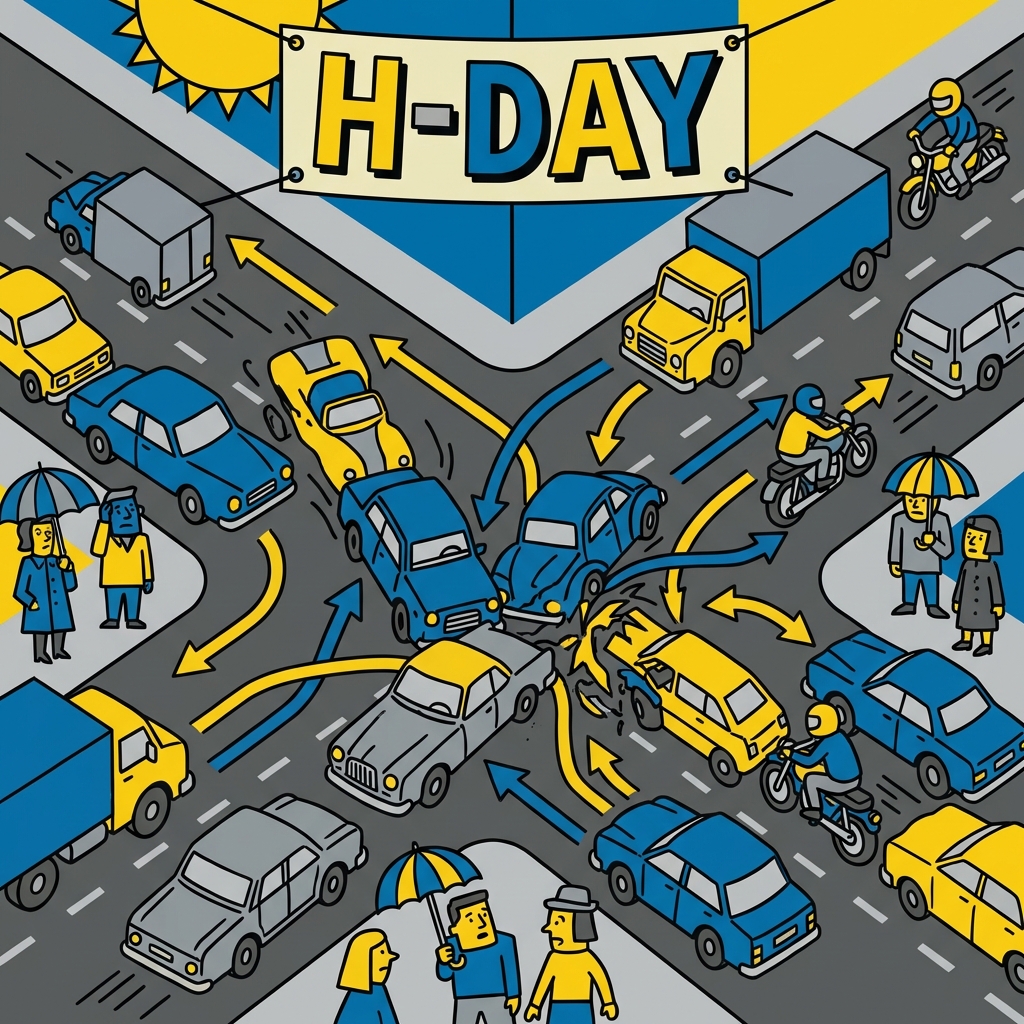
Traffic lights across the country switched off. For ten minutes, the roads were still. Then, at 5:00 AM, drivers pulled to the right side of the road and resumed driving. Sweden had just changed from left-hand to right-hand traffic, and the transition happened all at once.
The switch, known as Dagen H (H-Day, where H stood for "Högertrafikomläggningen," meaning "the right-hand traffic diversion"), was the culmination of years of planning and one of the largest logistical operations in the country's peacetime history. Sweden had driven on the left since the 18th century, but by the 1960s, the situation had become impractical. All of Sweden's neighbors—Norway, Denmark, and Finland—drove on the right. Cross-border traffic was confusing and dangerous. More critically, most Swedish cars were already left-hand drive, designed for right-hand traffic. Swedes were essentially driving cars built for the wrong side of the road.
A 1955 referendum on the switch had failed overwhelmingly—83 percent voted against. The Swedish parliament overruled the result in 1963, concluding that the safety arguments were too strong to ignore. They spent four years preparing.
The preparation was exhaustive. Every intersection in the country had to be rebuilt. Bus stops were repositioned. One-way streets were reversed. Road signs were redesigned and pre-installed, covered with black plastic until the day of the switch. Headlights on every car in Sweden had to be adjusted. The government ran a massive public information campaign, including a contest to design the official Dagen H logo—a simple white H on a blue and red background—and a song contest. The winning entry, "Håll dig till höger, Sansen" ("Keep to the Right, Sansen"), reached number five on the Swedish charts.
On the day itself, the transition went more smoothly than anyone expected. Accident rates actually dropped in the weeks immediately following the switch, likely because drivers were paying extra attention. Within a few months, the rates returned to normal.
Filed under Culture & Words, Quirky, EuropeFurther reading: Wikipedia
Print it for the office looPick your next sheet
Judge a story by its emoji. No peeking at titles.