Cher Ami
In October 1918, during the final weeks of World War I, a battalion of the U.S. 77th Infantry Division advanced into the Argonne Forest in northeastern France and became trapped.
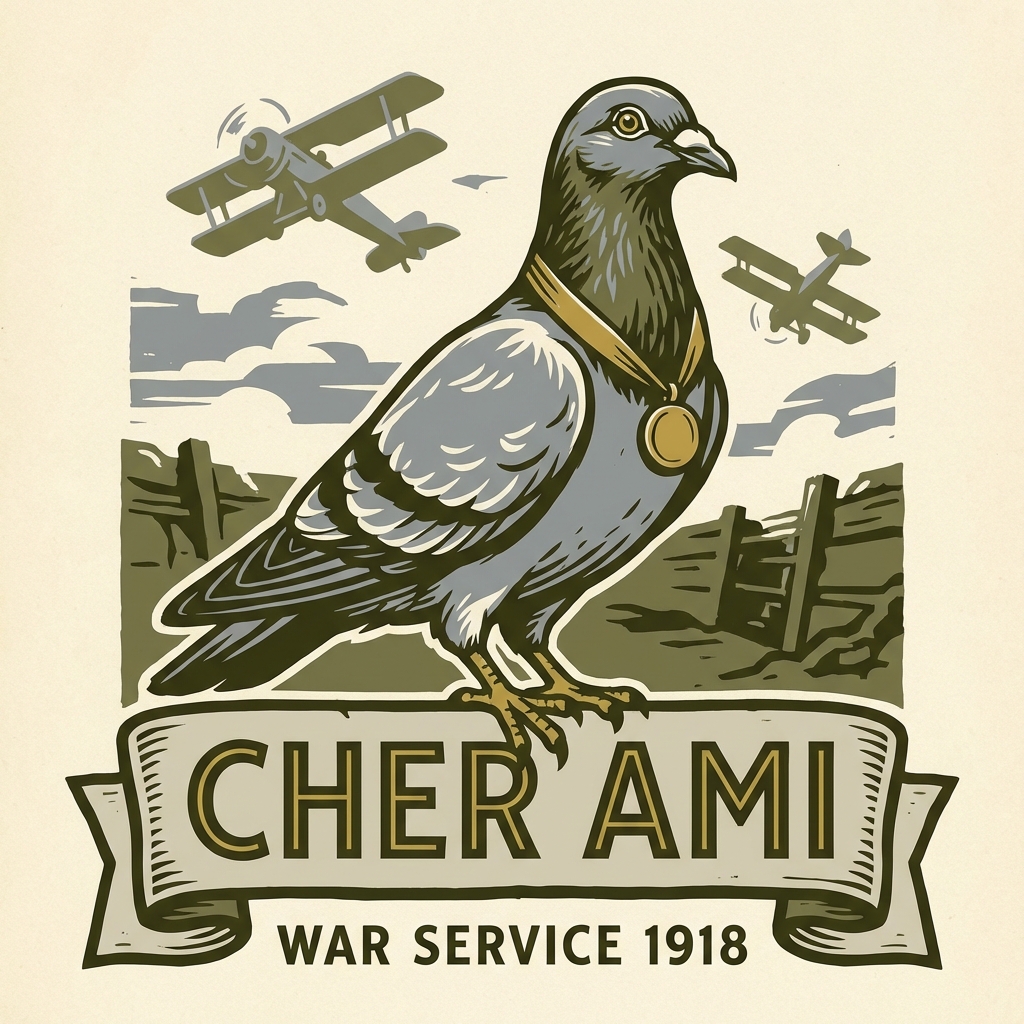
Roughly 550 men under the command of Major Charles Whittlesey had pushed ahead of the main line and found themselves surrounded by German forces in a ravine with no communication lines intact. They couldn't call for help. Worse, American artillery, unaware of their position, began shelling them.
Whittlesey sent carrier pigeons with messages to the rear, as was standard practice when wires were cut. The first pigeon was shot down. The second was shot down. The last pigeon available was a Black Check cock named Cher Ami—French for "Dear Friend."
At 3:15 PM on October 4, Cher Ami was released with a message clipped to his left leg: "We are along the road parallel to 276.4. Our own artillery is dropping a barrage directly on us. For heaven's sake, stop it." Almost immediately, German soldiers opened fire on the bird. Cher Ami was hit but kept flying.
The pigeon arrived at division headquarters 25 miles away in about 25 minutes. He had been shot through the breast, blinded in one eye, and his left leg—the one carrying the message—was hanging by a tendril. The message capsule was still attached. Army medics saved the bird's life but couldn't save the leg. The artillery bombardment was redirected, and reinforcements reached the Lost Battalion, as it came to be known, on October 7. Of the original 550, about 194 walked out.
Cher Ami was awarded the French Croix de Guerre with palm for his service. Army medics carved a small wooden leg for him. He was shipped back to the United States, where he became a minor celebrity, and died on June 13, 1919, less than a year after his flight. His taxidermied body is on display at the Smithsonian Institution's National Museum of American History, still wearing the wooden leg.
Filed under Heartwarming, Disasters & Drama, Animals & NatureFurther reading: Wikipedia
Print it for the office looPick your next sheet
Judge a story by its emoji. No peeking at titles.