Why Your Voice Sounds Different on Recordings
Almost everyone dislikes the sound of their own voice on a recording. The experience is so universal that psychologists have given it a name: voice confrontation. The reason is physiological, and it has to do with how sound reaches your ears.
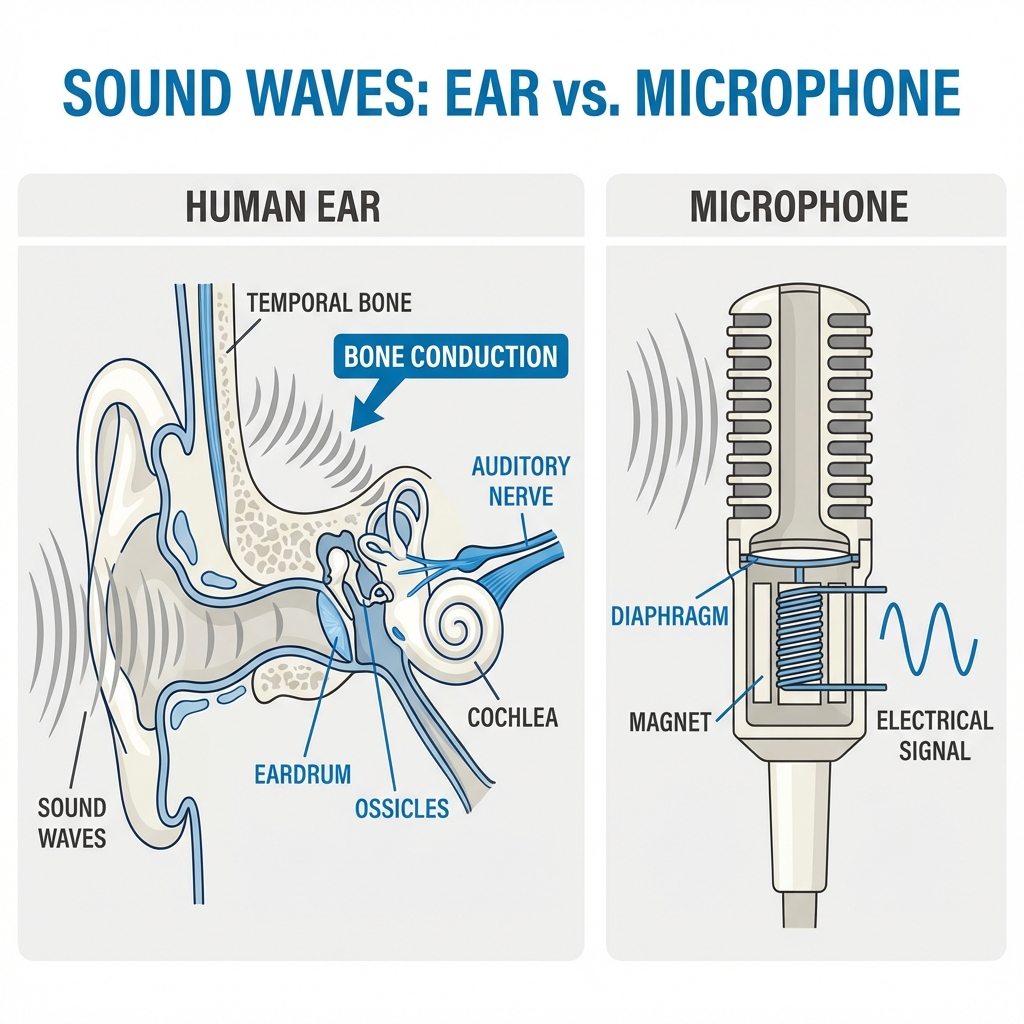
When you speak, your voice reaches your ears through two separate pathways simultaneously. The first is external: sound waves travel out of your mouth, through the air, and into your ear canals, just as they do for anyone listening to you. The second is internal: vibrations from your vocal cords travel through the bones and tissues of your skull directly to your inner ear. This bone-conducted sound arrives alongside the air-conducted sound, and your brain combines them into a single perception—your voice as you hear it in real time.
Bone conduction transmits lower frequencies more efficiently than air does. The result is that the voice you hear inside your head is deeper and richer than what everyone else hears. A recording captures only the external, air-conducted component—the version of your voice that reaches a microphone the same way it reaches other people's ears. When you play it back, the lower frequencies you've always heard are missing, and your voice sounds thinner, higher, and unfamiliar.
The discomfort isn't just acoustic. A 2013 study at Albright College found that people could reliably recognize their own voice on a recording but consistently rated it as less attractive than other people did. The researchers suggested that the gap between your internal voice and the recorded version creates a kind of cognitive dissonance—you've lived with one voice your entire life, and hearing a different one is unsettling in a way that goes beyond simple preference.
Interestingly, the effect works in reverse with faces. People tend to prefer photographs of themselves that are mirror-reversed—the version they see in the mirror every day—rather than the true image that everyone else sees. Both effects point to the same principle: familiarity shapes preference, and we've each internalized a slightly inaccurate version of how we present to the world.
Filed under Modern Times, ScienceFurther reading: Wikipedia
Print it for the office looPick your next sheet
Judge a story by its emoji. No peeking at titles.