Hedy Lamarr
Hedy Lamarr was one of the biggest movie stars of the 1940s. She was also the co-inventor of a frequency-hopping communication system that laid the conceptual groundwork for modern Wi-Fi, Bluetooth, and GPS. Neither career knew much about the other.
Born Hedwig Eva Maria Kiesler in Vienna in 1914, Lamarr was already a controversial figure in European cinema by the time she was nineteen. Her appearance in the 1933 Czech film *Ecstasy* included what is widely considered the first depiction of a female orgasm in a non-pornographic film. She fled an unhappy marriage to a wealthy Austrian arms dealer, Friedrich Mandl, who had connections to both Mussolini and the Nazi regime. During their marriage, she had attended technical meetings with Mandl's defense clients, absorbing details about military communications and torpedo guidance systems.
After arriving in Hollywood and signing with MGM, Lamarr became one of the most recognized faces in America. She also grew bored. She kept an inventing workshop in her home and developed ideas in her spare time, including an improved traffic signal and a fizzing tablet that turned water into cola (the tablet, by her own admission, didn't work very well).
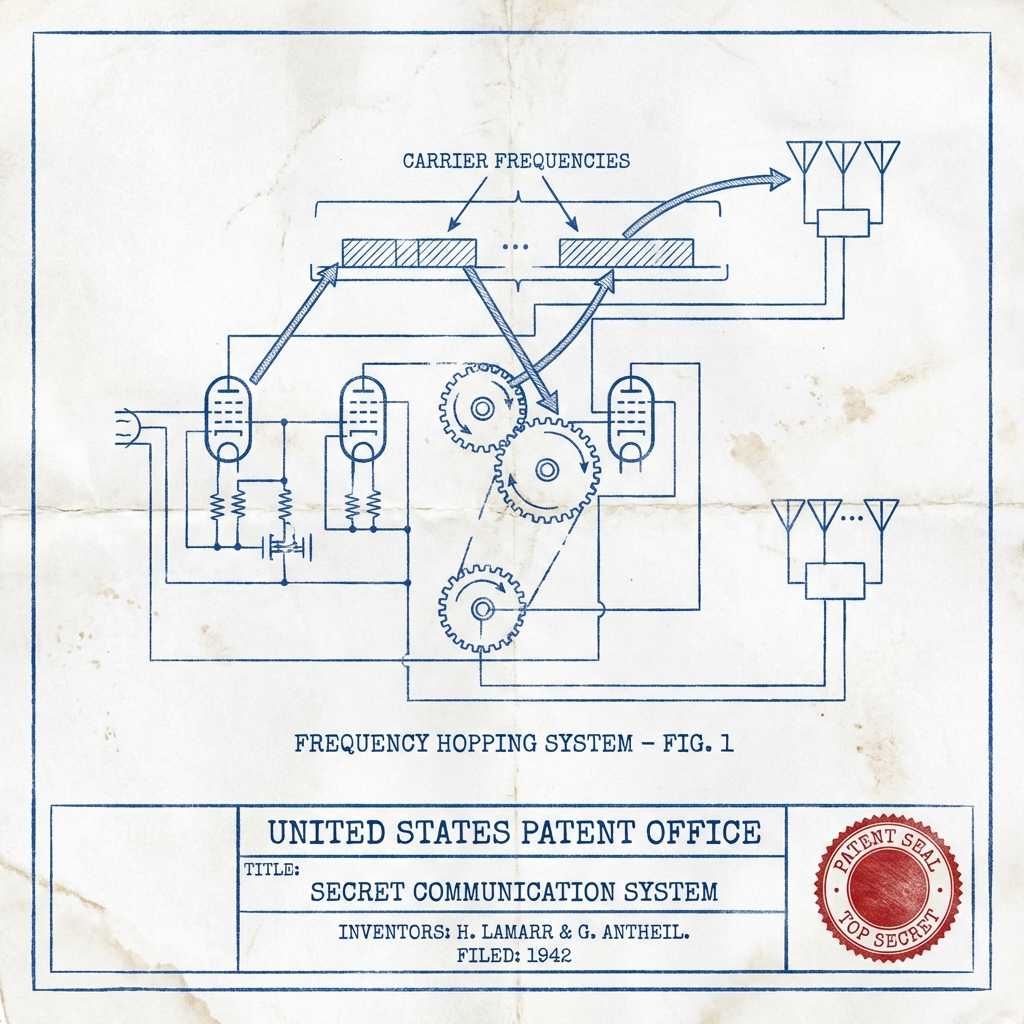
Her most significant invention emerged from conversations with George Antheil, an avant-garde composer known for composing music for synchronized player pianos. Together, they developed a system in which a radio signal would rapidly switch between frequencies according to a pattern known to both transmitter and receiver—making it nearly impossible for an enemy to jam the signal. They patented the technology in 1942 under Lamarr's married name, Hedy Kiesler Markey, and offered it to the U.S. Navy for torpedo guidance.
The Navy declined to use it during World War II. The patent expired in 1959. In the 1960s, engineers developing secure military communications independently arrived at the same principle—spread-spectrum technology—and the original Lamarr-Antheil patent was eventually recognized as a foundational contribution. The same principle now underpins the frequency-hopping protocols in wireless communication systems worldwide.
Lamarr received the Electronic Frontier Foundation's Pioneer Award in 1997. She reportedly responded: "It's about time."
Filed under Heartwarming, Inventions, AmericaFurther reading: Wikipedia
Print it for the office looPick your next sheet
Judge a story by its emoji. No peeking at titles.