The Tunguska Event
On the morning of June 30, 1908, something exploded in the sky above a remote stretch of Siberian forest.
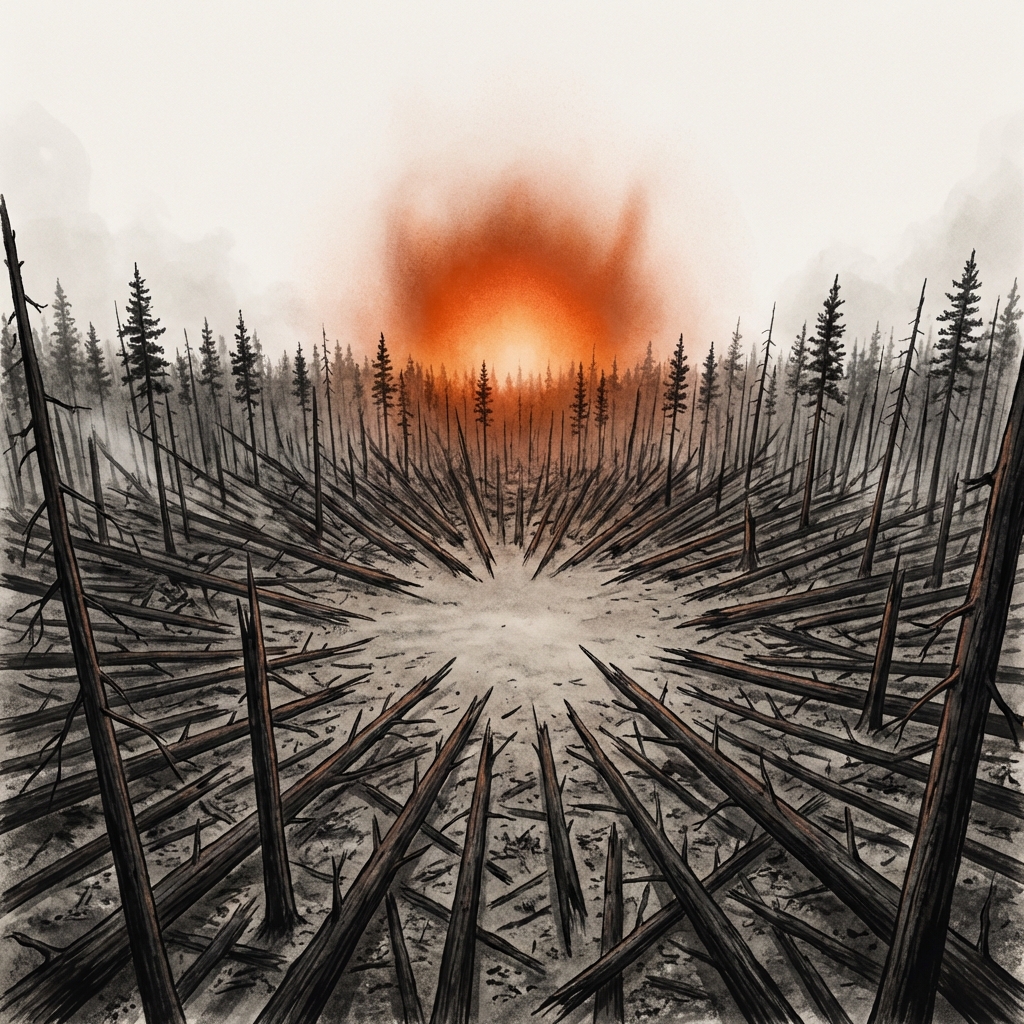
The blast flattened an estimated 80 million trees across 830 square miles, knocked people off their feet 40 miles away, and released energy equivalent to roughly 15 megatons of TNT—a thousand times more powerful than the atomic bomb dropped on Hiroshima. Nothing hit the ground.
The few witnesses were Evenki reindeer herders, none closer than 20 miles from the epicenter. They described a fireball trailing smoke across the sky, then a flash brighter than the sun, followed by a thunderous boom. The explosion generated seismic waves that registered on instruments across Europe and Asia. For several nights afterward, the skies over much of the Northern Hemisphere glowed so brightly that Londoners could read newspapers outside at midnight.
The location was so remote that no scientific expedition reached the site until 1927, when Russian mineralogist Leonid Kulik led a team to the Podkamennaya Tunguska River basin. Even nineteen years later, the devastation was unmistakable. Kulik found trees flattened in a radial pattern stretching 15 to 30 kilometers from the epicenter, all pointing away from a central point where the forest had been scorched bare. But there was no crater.
The absence of a crater led scientists to conclude that whatever had exploded never reached the surface. Current estimates suggest a stony asteroid roughly 50 to 60 meters wide entered the atmosphere at high speed and detonated at an altitude of 5 to 10 kilometers. The energy of its disintegration created a shockwave powerful enough to level the forest below without leaving an impact site.
The Tunguska event remains the largest recorded impact event in human history. Had it occurred over a populated area, the casualties would have been catastrophic. Instead, it happened over one of the emptiest places on Earth, leaving only flattened trees and a century of scientific debate about whether the object was an asteroid or a comet.
Filed under Disasters & Drama, Animals & Nature, ScienceFurther reading: Wikipedia
Print it for the office looPick your next sheet
Judge a story by its emoji. No peeking at titles.