Why We Get Goosebumps
When you're cold or frightened, tiny muscles at the base of each hair follicle contract, pulling the hair upright and creating a small bump on the skin. The response is called piloerection, and in humans it serves almost no practical purpose. It's a vestige of a time when our ancestors had enough body hair for the reflex to matter.
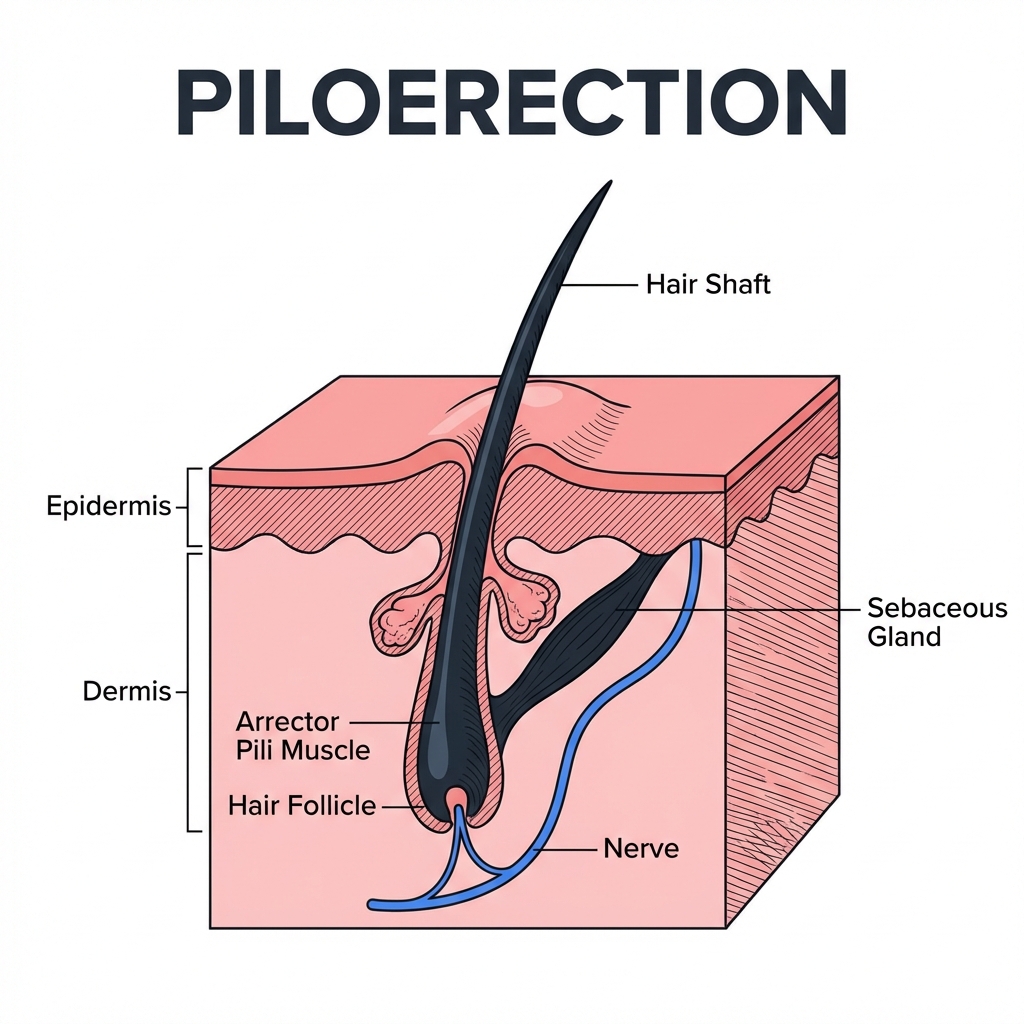
In furred animals, piloerection does two things. First, it traps air between the raised hairs, creating an insulating layer that retains body heat—essentially fluffing up a natural coat. Cats and dogs do this when cold, and it's measurably effective at reducing heat loss. Second, it makes the animal appear larger. A cat arching its back with fur standing on end looks significantly bigger than one with flat fur. For an animal facing a predator, the extra apparent size can be the difference between a fight and a retreat.
Humans inherited the reflex but lost the fur. The tiny bumps we produce don't trap meaningful insulation, and they don't make us look any bigger. The muscles still contract, the hairs still rise—they're just too short and sparse to accomplish anything. It's a behavioral fossil.
What's interesting is that the reflex also triggers in response to strong emotions—awe, fear, nostalgia, particular pieces of music. This suggests the mechanism isn't purely thermoregulatory. The autonomic nervous system, which controls piloerection, also governs heart rate, pupil dilation, and the fight-or-flight response. Goosebumps appear to be tied into the broader system of involuntary physical reactions to emotionally significant stimuli.
A 2020 study at Harvard found that the same sympathetic nerves that trigger piloerection also stimulate stem cells in the hair follicle. Cold exposure, mediated through the same nerve-muscle connection, actually promotes hair growth in mice. The reflex, in other words, isn't just a leftover—it may play a role in regenerating the very hair it evolved to raise.
The emotional trigger remains less well understood. Why a particular piece of music or a moment of recognition should activate the same circuit as cold air is an open question.
Filed under Modern Times, ScienceFurther reading: Wikipedia
Print it for the office looPick your next sheet
Judge a story by its emoji. No peeking at titles.